


Page 69 - (DK Eyewitness) Travel Guide 2016 - Austria
P. 69
INNER c I ty 67
a Neo-Classical façade and a rebuilt in 1837–48, under the
magnificent Baroque interior, supervision of Ludwig Pichl.
which still bears features of its In the courtyard, a tablet from
former Romanesque decor. 1571 warns visitors not to carry
Above the tabernacle stands weapons or fight here. The
the 13th-century statue of Our injunction was famously ignored
Lady, the oldest Romanesque when the 1848 Revolution
sculpture in Vienna. was ignited on this very spot.
The adjacent abbey buildings In 1918 the Republic was
house a picture gallery with proclaimed from the Landhaus.
an interesting collection of
medieval art.
Other interesting buildings
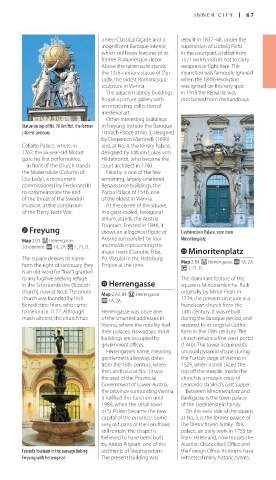
Statue on top of No. 10 Am Hof, the former in Freyung include the Baroque
citizens’ armoury Harrach Palace at No. 3, designed
by Domenico Martinelli (1690)
Collalto Palace, where, in and, at No. 4, the Kinsky Palace,
1762, the six-year-old Mozart designed by Johann Lukas von
gave his first performance. Hildebrandt, who became the
In front of the church stands court architect in 1700.
the Mariensäule (Column of Nearby is one of the few
Our Lady), a monument remaining, largely unaltered
commis sio ned by Ferdinand III Renaissance buildings, the
to comme morate the end Porcia Palace of 1546, one
of the threat of the Swedish of the oldest in Vienna.
invasion, at the conclusion At the centre of the square,
of the Thirty Years’ War. in a glass-roofed, hexagonal
atrium, stands the Austria
Fountain. Erected in 1846, it
a Freyung shows an allegorical figure of Liechtenstein Palace, seen from
Map 2 B3. % Herrengasse, Austria surrounded by four Minoritenplatz
Schottentor. @ 1A, 2A. v 1, 71, D. mermaids representing the
major rivers (Danube, Elbe, d Minoritenplatz
The square derives its name Po, Vistula) in the Habsburg Map 2 B4. % Herrengasse. @ 1A, 2A.
from the right of sanctuary (frey Empire at the time. v 1, 71, D.
is an old word for “free”) granted
to any fugitive seeking refuge The dominant feature of the
in the Schottenkirche (Scottish s Herrengasse square is Minoritenkirche. Built
church), now at No. 6. The priory Map 2 A3, B4. % Herrengasse. originally by Minor Friars in
church was founded by Irish @ 1A, 2A. 1224, the present structure is a
Benedictine friars, who came Franciscan church from the
to Vienna in 1177. Although Herrengasse was once one 14th century. It was rebuilt
much altered, the church has of the smartest addresses in during the Baroque period, and
Vienna, where the nobility had restored to its original Gothic
their palaces. Nowadays, most form in the 19th century. The
buildings are occupied by church retains a fine west portal
government offices. (1340). The tower acquired its
Herrengasse’s name, meaning unusual pyramid shape during
gentlemen’s alleyway, dates the Turkish siege of Vienna in
from the 16th century, when 1529, when a shell sliced the
the Landhaus at No. 13 was top off the steeple. Inside the
the seat of the Provincial church is a mosaic copy of
Government of Lower Austria, Leonardo da Vinci’s Last Supper.
the province surrounding Vienna. Between Minoritenplatz and
It fulfilled this function until Bankgasse is the town palace
1986, when the small town of the Liechtenstein family.
of St Pölten became the new On the west side of the square,
capital of the province. Some at No. 3, is the former palace of
very old parts of the Landhaus the Dietrichstein family. This
still remain; the chapel is palace, an early work in 1755 by
believed to have been built Franz Hillebrand, now houses the
by Anton Pilgram, one of the Austrian Chancellor’s Office and
Ferstel’s fountain in the passage linking architects of Stephansdom. the Foreign Office. Its rooms have
Freyung with Herrengasse The present building was witnessed many historic events.
066-067_EW_Austria.indd 67 03/09/15 5:41 pm

