


Page 86 - (DK Eyewitness) Travel Guide 2016 - Austria
P. 86
84 VIENNA AREA B Y AREA
9 Dreifaltigkeits- q Maria-Treu-Kirche
kirche der Minoriten Jodok-Fink-Platz. Map 1 B3.
Alser Strasse 17. Map 1 B2. Tel 40 57 Tel 40 50 425. % Rathaus. v 2.
225. % Rathaus. v 5, 33, 43, 44. @ 13A. Open during mass or
Open 7:30am–noon Mon–Fri, Sun, by appointment.
7:30–8:30am Sat.
Originally designed by Johann
Built between 1685 and 1727, Lukas von Hildebrandt in 1716,
the church of the Holy Trinity Maria Treu Kirche (church of
is a typical Baroque structure, Mary the Faithful) acquired its
with a twin-tower façade. It present form in the mid-19th
contains an altarpiece (1708) century, when twin towers
in the north aisle by the painter were added.
Martino Altomonte, and a The church, as well as the
beautiful crucifix in the south adjacent monastic buildings, was
aisle from the workshop of Entrance to the Museum für Volks kunde, founded by fathers of the Piarist
Veit Stoss. Schönborn Palace Order, one of whose main aims
In 1827, the body of the is education; they also founded
composer Ludwig van Beethoven premises, the former Schönborn a primary and a secondary
was brought to this church, Palace, built in 1706–11 to school next door. The homely
from Schwarzspanierhaus in designs by Johann Lukas von cellar of the former monastery
neighbouring Garnisonsgasse Hildebrandt as a homely two- is today a pleasant restaurant.
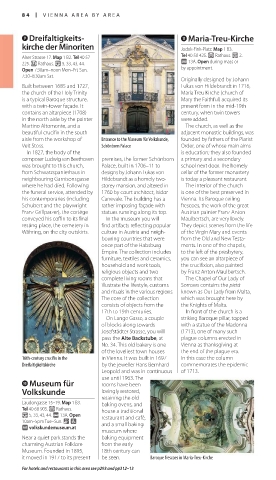
where he had died. Following storey mansion, and altered in The interior of the church
the funeral service, attended by 1760 by court architect, Isidor is one of the best preserved in
his contemporaries (including Canevale. The building has a Vienna. Its Baroque ceiling
Schubert and the playwright rather imposing façade with frescoes, the work of the great
Franz Grillparzer), the cortège statues running along its top. Austrian painter Franz Anton
conveyed his coffin to its final In the museum you will Maulbertsch, are very lovely.
resting place, the cemetery in find artifacts reflecting popular They depict scenes from the life
Währing, on the city outskirts. culture in Austria and neigh- of the Virgin Mary and events
bouring countries that were from the Old and New Testa-
once part of the Habsburg ments. In one of the chapels,
Empire. The collection includes to the left of the presbytery,
furniture, textiles and ceramics, you can see an altarpiece of
household and work tools, the crucifixion, also painted
religious objects and two by Franz Anton Maulbertsch.
com plete living rooms that The Chapel of Our Lady of
illustrate the lifestyle, customs Sorrows contains the pietà
and rituals in the various regions. known as Our Lady from Malta,
The core of the collection which was brought here by
consists of objects from the the Knights of Malta.
17th to 19th centuries. In front of the church is a
On Lange Gasse, a couple striking Baroque pillar, topped
of blocks along towards with a statue of the Madonna
Josefstädter Strasse, you will (1713), one of many such
pass the Alte Backstube, at plague columns erected in
No. 34. This old bakery is one Vienna as thanksgiving at
of the loveliest town houses the end of the plague era.
16th-century crucifix in the in Vienna. It was built in 1697 In this case the column
Dreifaltigkeitskirche by the jeweller Hans Bernhard commemorates the epidemic
Leopold and was in continuous of 1713.
use until 1963. The
0 Museum für rooms have been
Volkskunde lovingly restored,
retaining the old
Laudongasse 15–19. Map 1 B3. baking ovens, and
Tel 40 68 905. % Rathaus. house a traditional
v 5, 33, 43, 44. @ 13A. Open restaurant and café,
10am–5pm Tue–Sun. & 7 and a small baking
∑ volkskundemuseum.at
museum where
Near a quiet park stands the baking equipment
charming Austrian Folklore from the early
Museum. Founded in 1895, 18th century can
it moved in 1917 to its present be seen. Baroque frescoes in Maria-Treu-Kirche
For hotels and restaurants in this area see p293 and pp312–13
084-085_EW_Austria.indd 84 03/09/15 5:41 pm

