


Page 46 - HeliOps Frontline Issue 26
P. 46
46   HELIOPS FRONTLINE  /  ISSUE 26  /  2019


                                               resistance to Improvised Explosive Devices. The increased weight
                                               of the Chinook, coupled with the heavier JLTV, results in less
                                               mission flexibility as fuel or payload needs to be traded – either
                                               the JLTV isn’t carried as far underslung or the vehicle is de-‘roled’
                                               to an extent.
                                                  The Army anticipated such a problem and initiated the CH-47F
                                               “Block II” program to ‘buy back’ some of the performance loss. The
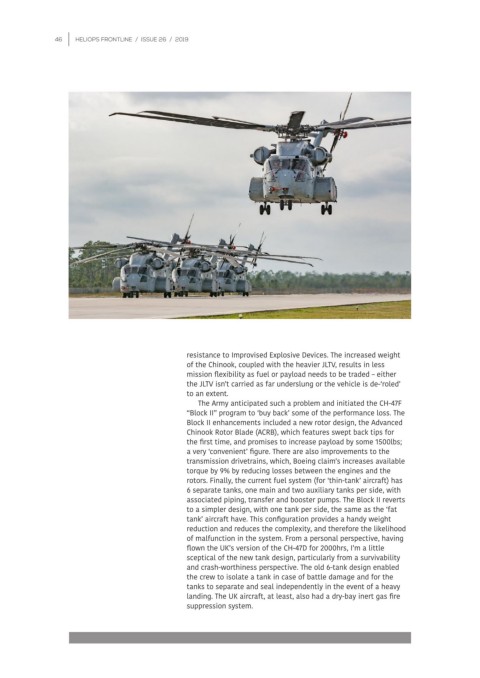
                                               Block II enhancements included a new rotor design, the Advanced
                                               Chinook Rotor Blade (ACRB), which features swept back tips for
                                               the first time, and promises to increase payload by some 1500lbs;
                                               a very ‘convenient’ figure. There are also improvements to the
                                               transmission drivetrains, which, Boeing claim’s increases available
                                               torque by 9% by reducing losses between the engines and the
                                               rotors. Finally, the current fuel system (for ‘thin-tank’ aircraft) has
                                               6 separate tanks, one main and two auxiliary tanks per side, with
                                               associated piping, transfer and booster pumps. The Block II reverts
                                               to a simpler design, with one tank per side, the same as the ‘fat
                                               tank’ aircraft have. This configuration provides a handy weight
                                               reduction and reduces the complexity, and therefore the likelihood
                                               of malfunction in the system. From a personal perspective, having
                                               flown the UK’s version of the CH-47D for 2000hrs, I’m a little
                                               sceptical of the new tank design, particularly from a survivability
                                               and crash-worthiness perspective. The old 6-tank design enabled
                                               the crew to isolate a tank in case of battle damage and for the
                                               tanks to separate and seal independently in the event of a heavy
                                               landing. The UK aircraft, at least, also had a dry-bay inert gas fire
                                               suppression system.

