


Page 293 - The Rough Guide to Panama (Travel Guide)
P. 293
History CONTEXTS  291
       History


       Though the Republic of Panama is only a little over a century old, humans
       have lived on the isthmus for thousands of years. Its location as a slender
       bridge between two vast land masses has been as crucial to its development
       as its eventual link between two expanses of ocean.


       Pre-Columbian society
       Panama’s scarce archeological remains give little clue to the societies that inhabited the
       region, in part because many early excavations were poorly executed and finds were
       damaged or looted. Lacking the huge structures and sophisticated carvings that epitomize
       the Maya, Aztec and Toltec civilizations of Mesoamerica, the trading societies of Central
       America have always taken a historical backseat. Yet central Panama boasts the earliest
       traces of pottery-making in the Americas with ceramics from Monagrillo, in the northern
       Azuero Peninsula, carbon-dated to 2500–1200 BC. A nearby fishing village in Sarigua is
       considered to be the isthmus’s oldest settlement, dating from around 11,000 BC.
        The most sophisticated societies inhabited central Panama, with the richest
       archeological finds in the necropolis of Sitio Conté, outside Penonomé. Excavations
       by American academics in the 1930s opened up around a hundred tombs to reveal
       thousands of intricate gold pieces of jewellery alongside sophisticated polychrome
       ceramics and other artefacts dating back to the first century, most of which were
       shipped off to the States.
        At El Caño, near Natá, lies a ceremonial site believed to have become a cemetery
       dating from 500 to 1200 AD, though its original function and significance is unknown,
       not helped by the fact that a US adventurer decapitated more than a hundred basalt
       standing stones. In the Western Highlands, outside Volcán, another important site
       indicates the existence of what has been termed the Barriles culture, at its apogee around
       500 to 600 AD, whose curious stone statues of a figure wearing a conical hat carrying
       another on its shoulders are on display at Panama City’s anthropological museum
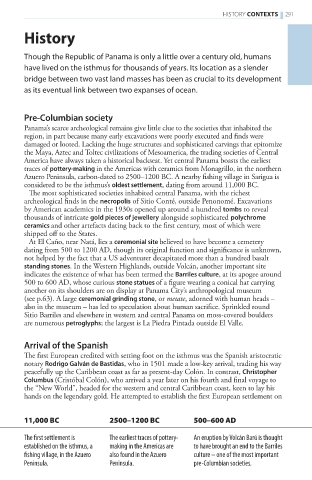
 GOLD PLAQUE, COCLÉ PROVINCE
       (see p.63). A large ceremonial grinding stone, or metate, adorned with human heads –
       also in the museum – has led to speculation about human sacrifice. Sprinkled round
       Sitio Barriles and elsewhere in western and central Panama on moss-covered boulders
       are numerous petroglyphs; the largest is La Piedra Pintada outside El Valle.

       Arrival of the Spanish
       The first European credited with setting foot on the isthmus was the Spanish aristocratic
       notary Rodrigo Galván de Bastidas, who in 1501 made a low-key arrival, trading his way
       peacefully up the Caribbean coast as far as present-day Colón. In contrast, Christopher
       Columbus (Cristóbal Colón), who arrived a year later on his fourth and final voyage to
       the “New World”, headed for the western and central Caribbean coast, keen to lay his
       hands on the legendary gold. He attempted to establish the first European settlement on


       11,000 BC           2500–1200 BC       500–600 AD
       The first settlement is   The earliest traces of pottery-  An eruption by Volcán Barú is thought
       established on the isthmus, a   making in the Americas are   to have brought an end to the Barriles
       fishing village, in the Azuero   also found in the Azuero   culture – one of the most important
       Peninsula.          Peninsula.         pre-Columbian societies.


   290-319_Panama_3_Contexts.indd   291                        30/06/17   11:52 am

