


Page 176 - (DK Eyewitness) Travel Guide - Prague
P. 176
174 PR A GUE AREA B Y AREA
A Two-Hour Walk along the Royal Route
The Royal Route originally linked two important royal
seats: the Royal Court – on the site of the Municipal House
and where the walk starts – and Prague Castle, where
the walk finishes. The name of this walk derives from the
coronation processions of the Bohemian kings and queens
who passed along it. Today, these narrow streets offer a
wealth of historical and architecturally interesting sights,
shops and cafés, making the walk one of Prague’s most
popular. For more details on the Old Town, the Little
Quarter and Hradčany turn to pages 62–81,
122–41 and 96–121 respectively.
History of the Royal Route
The first major coronation
procession to travel along
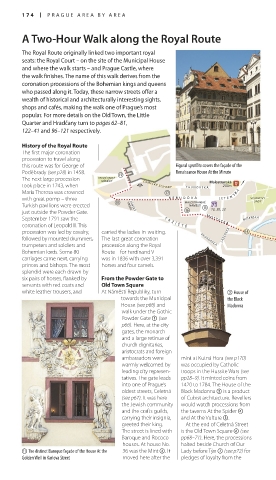
this route was for George of Figural sgraffito covers the façade of the
Poděbrady (see p28) in 1458. Renaissance House At the Minute
The next large procession HRADČANSKÉ o Malostranská
NÁMĚSTÍ
took place in 1743, when ZÁMECKÉ SCH ODY T H U N O V S K Á 200m
Maria Theresa was crowned u N E R U D O V A L E T E N S K Á REVOLUČNI 5, 8, 14
with great pomp – three VOJANOVY D LOU H Á K A
SADY
Turkish pavilions were erected i VRŠEK JÁNSKÝ MALOSTRANSKÉ t PAŘIŽSKÁ TÝN SKÁ J A K U B S KRALO DVO RSKÁ NA POŘÍČÍ
NÁMĚSTÍ
just outside the Powder Gate. y 12, 20, 22 STAROMĚSTSKÉ Náměstí
NÁMĚSTÍ
September 1791 saw the T R Ž Í Š T Ě M O S T E C K Á MÍŠEŇSKÁ V l t a v a 6 7 Š T U P A R T S K Á Republiky
4
NÁMĚSTÍ
coronation of Leopold II. This K Á P L A T N É Ř S K Á 9 C E L E T N Á 1 REPUBLIKY
procession was led by cavalry, carried the ladies-in-waiting. LÁZEŇSKÁ r C MALÉ 0 8 5 3 2
followed by mounted drummers, The last great coronation PROKOPSKÁ e Karlův most N I NÁMĚSTÍ OVOCNÝ
TRH
trumpeters and soldiers and procession along the Royal w O V SEMINÁŘSKÁ K A R L O V A MELANTRICHOVA Ž E L E Z N Á
Bohemian lords. Some 80 Route – for Ferdinand V – Ž K A R L O V A q
carriages came next, carrying was in 1836 with over 3,391 Ř I A N E N S K Á H US
princes and bishops. The most horses and four camels. K 17, 18 L I L I O V Á ŘETĒZOVĀ OV A
splendid were each drawn by
six pairs of horses, flanked by From the Powder Gate to
servants with red coats and Old Town Square
white leather trousers, and At Náměstí Republiky, turn 3 House of
towards the Municipal the Black
House (see p66) and Madonna
walk under the Gothic
Powder Gate 1 (see
p66). Here, at the city
gates, the monarch
and a large retinue of
church dignitaries,
aristocrats and foreign
ambassadors were mint at Kutná Hora (see p170)
warmly welcomed by was occupied by Catholic
leading city represen- troops in the Hussite Wars (see
tatives. The gate leads pp28–9). It minted coins from
into one of Prague’s 1420 to 1784. The House of the
oldest streets, Celetná Black Madonna 3 is a product
(see p67). It was here of Cubist architec ture. Revellers
the Jewish community would watch processions from
and the crafts guilds, the taverns At the Spider 4
carrying their insignia, and At the Vulture 5.
greeted their king. At the end of Celetná Street
The street is lined with is the Old Town Square 6 (see
Baroque and Rococo pp68–71). Here, the processions
houses. At house No. halted beside Church of Our
q The distinct Baroque façade of the House At the 36 was the Mint 2. It Lady before Týn 7 (see p72) for
Golden Well in Karlova Street moved here after the pledges of loyalty from the
174-175_EW_Prague.indd 174 20/03/17 11:29 am
Eyewitness Travel LAYERS PRINTED:
Catalogue template “UK” LAYER
(Source v1.9)
Date 20th August 2012
Size 125mm x 217mm

