


Page 183 - (DK Eyewitness) Travel Guide - Prague
P. 183
FOUR GUIDED W ALKS 181
1420. About 20 m Gothic church. Since then,
(65 ft) past the it has been redecorated and
basilica, turn right restored many times in a
on to the fortified variety of styles. In 1885, it
walls for a stunning was finally rebuilt in Neo-
view of Prague. Gothic style, the twin steeples
being added in 1902. Note
Vyšehrad Rock the early 12th-century stone
The wooded outcrop coffin, thought to be of St
of rock on which Longinus, and a mid-14th-
Vyšehrad was built century Gothic panel painting
drops in the west to Our Lady of the Rains on the
form a steep rock altar in the third chapel on
wall to the river – the right.
a vital defensive
position. On the Vyšehrad Cemetery and
summit of the rock the Pantheon
are the Gothic ruins The cemetery r was founded
3, 17, 21
V N I S L A V O of the so-called in 1869 as the burial place for
Libuše’s Baths 0. some of the country’s most
V
R
A
This was a defence famous figures, such as Bedřich
A
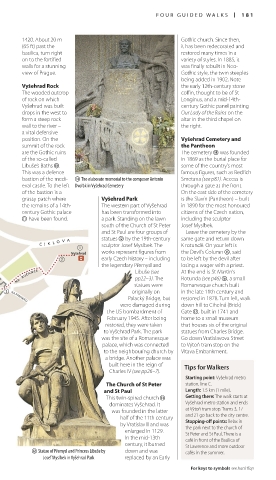
bastion of the medi- r The elaborate memorial to the composer Antonín Smetana (see p81). Access is
N E K L A N O V A
V R A T I S L A V O V A
eval castle. To the left Dvořák in Vyšehrad Cemetery through a gate at the front.
of the bastion is a On the east side of the cemetery
u
grassy patch where Vyšehrad Park is the Slavín (Pantheon) – built
r the remains of a 14th- The western part of Vyšehrad in 1890 for the most honoured
century Gothic palace has been transformed into citizens of the Czech nation,
N E K L A N O V A
S L A V O J O V A
e q have been found. a park. Standing on the lawn including the sculptor
V P E V N O S T I
t
Š Ī N O V O N Á B Ř E Ž Í
VYŠEHRADSKÉ K R O T U N D Ĕ y south of the Church of St Peter Josef Myslbek.
SADY and St Paul are four groups of Leave the cemetery by the
8
w SOBĚSLAVOVA 9 7 statues w by the 19th-century same gate and return down
Č I K L O V A
q L U M Í R O V A 1 sculptor Josef Myslbek. The K rotundě. On your left is
5 Vyšehrad works represent figures from the Devil’s Column t, said
0 6 2 early Czech history – including to be left by the devil after
the legendary Přemysl and losing a wager with a priest.
NA BUČAN CE originally on Romanesque church built
V P E V N OST I
pp22–3). The
Rotunda (see p46) y, a small
4 Libuše (see At the end is St Martin’s
statues were
U P O D O L S K É H O S A N A T O R I A
3
in the late 11th century and
Palacký Bridge, but
NA PANKRÁCI
were damaged during
down hill to Cihelná (Brick)
PODOLSK É the US bombardment of restored in 1878. Turn left, walk
Gate u, built in 1741 and
February 1945. After being home to a small museum
restored, they were taken that houses six of the original
to Vyšehrad Park. The park statues from Charles Bridge.
was the site of a Romanesque Go down Vratislavova Street
palace, which was connected to Výtoň tram stop on the
to the neighbouring church by Vltava Embankment.
a bridge. Another palace was
built here in the reign of Tips for Walkers
Charles IV (see pp26–7).
Starting point: Vyšehrad metro
The Church of St Peter station, line C.
and St Paul Length: 1.5 km (1 mile).
This twin-spired church e Getting there: The walk starts at
dominates Vyšehrad. It Vyšehrad metro station and ends
was founded in the latter at Výtoň tram stop. Trams 3, 17
half of the 11th century and 21 go back to the city centre.
Stopping-off points: Relax in
by Vratislav II and was the park next to the church of
enlarged in 1129. St Peter and St Paul. There is a
In the mid-13th café in front of the Basilica of
century, it burned St Lawrence and more outdoor
w Statue of Přemysl and Princess Libuše by down and was cafés in the summer.
Josef Myslbek in Vyšehrad Park replaced by an Early
For keys to symbols see back flap
180-181_EW_Prague.indd 181 20/03/17 11:29 am

