


Page 88 - (DK Eyewitness) Travel Guide - Prague
P. 88
86 І PR A GUE AREA B Y AREA
French NeoRenaissance style,
was completed in 1901. The
museum’s glass collection is one
of the largest in the world, but
only a fraction of it is ever on
display. Pride of place goes to
the Bohemian glass, of which
there are many fine Baroque
and 19th and 20thcentury
pieces. Medieval and Venetian
Renaissance glass are also
well represented.
Among the permanent
exhibitions of other crafts are
Meissen porcelain, the Gobelin
tapestries and displays covering
fashion, textiles, photography
and printing. The fine furniture
collection has exquisitely carved
escritoires and bureaux from the
Renaissance. On the mezzanine
floor are halls for temporary
exhibitions and an extensive
art library housing more than
100,000 publications.
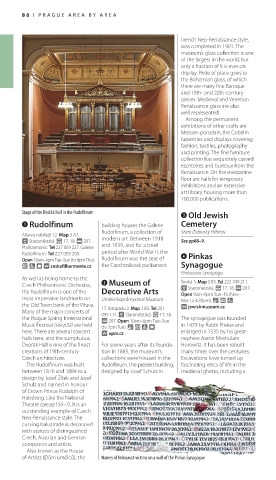
Stage of the Dvořák Hall in the Rudolfinum
3 Old Jewish
1 Rudolfinum building houses the Galerie Cemetery
Rudolfinum, a collection of Starý Židovský Hřbitov
Alšovo nábřeží 12. Map 3 A3.
X Staroměstská. v 17, 18. @ 207. modern art. Between 1918 See pp88–9.
Philharmonic: Tel 227 059 227. Galerie and 1939, and for a brief
Rudolfinum: Tel 227 059 205. period after World War II, the 4 Pinkas
Open 10am–6pm Tue–Sun (to 8pm Thu). Rudolfinum was the seat of
^ 7 - ∑ ceskafilharmonie.cz the Czechoslovak parliament. Synagogue
Pinkasova Synagoga
As well as being home to the Široká 3. Map 3 B3. Tel 222 749 211.
Czech Philharmonic Orchestra, 2 Museum of X Staroměstská. v 17, 18. @ 207.
the Rudolfinum is one of the Decorative Arts Open 9am–6pm Sun–Fri (Nov–
most impressive landmarks on Uměleckoprůmyslové Muzeum Mar: to 4:30pm). & ^ 7
the Old Town bank of the Vltava. 17. listopadu 2. Map 3 B3. Tel 251 ∑ jewishmuseum.cz
Many of the major concerts of 093 111. X Staroměstská. v 17, 18.
the Prague Spring International @ 207. Open 10am–6pm Tue–Sun The synagogue was founded
Music Festival (see p52) are held (to 7pm Tue). & ^ 7 - in 1479 by Rabbi Pinkas and
here. There are several concert ∑ upm.cz enlarged in 1535 by his great
halls here, and the sumptuous nephew Aaron Meshulam
Dvořák Hall is one of the finest For some years after its founda Horowitz. It has been rebuilt
creations of 19thcentury tion in 1885, the museum’s many times over the centuries.
Czech architecture. collections were housed in the Excavations have turned up
The Rudolfinum was built Rudolfinum. The present building, fascinating relics of life in the
between 1876 and 1884 to a designed by Josef Schulz in medieval ghetto, including a
design by Josef Zítek and Josef
Schulz and named in honour
of Crown Prince Rudolph of
Habsburg. Like the National
Theatre (see pp156–7), it is an
outstanding example of Czech
NeoRenaissance style. The
curving balustrade is decorated
with statues of distinguished
Czech, Austrian and German
composers and artists.
Also known as the House
of Artists (Dům umělců), the Names of Holocaust victims on a wall of the Pinkas Synagogue
086-087_EW_Prague.indd 86 22/03/2017 12:30
Eyewitness Travel LAYERS PRINTED:
Catalogue template “UK” LAYER
(Source v1.9)
Date 20th August 2012
Size 125mm x 217mm

