


Page 95 - (DK Eyewitness) Travel Guide - Prague
P. 95
JE WISH QU AR TER 93
19th century. The exterior and
interior are both pseudo-Moorish
in appearance. The rich stucco
deco rations on the walls and
vaults are reminiscent of the
Alhambra in Spain, hence the
name. Once closed to the public,
the Spanish Synagogue now
houses a per manent exhibition
dedicated to the history of the
Jews from emancipation to
the present.
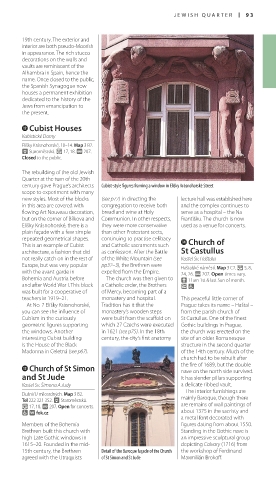
w Cubist Houses
Kubistické Domy
Elišky Krásnohorské, 10–14. Map 3 B2.
X Staroměstská. v 17, 18. @ 207.
Closed to the public.
The rebuilding of the old Jewish
Quarter at the turn of the 20th
century gave Prague’s architects Cubist-style figures framing a window in Elišky Krásnohorské Street
scope to experiment with many
new styles. Most of the blocks (see p77) in directing the lecture hall was established here
in this area are covered with congregation to receive both and the complex continues to
flowing Art Nouveau decoration, bread and wine at Holy serve as a hospital – the Na
but on the corner of Bílkova and Communion. In other respects, Františku. The church is now
Elišky Krásnohorské, there is a they were more conservative used as a venue for concerts.
plain façade with a few simple than other Protestant sects,
repeated geometrical shapes. continuing to practise celibacy r Church of
This is an example of Cubist and Catholic sacraments such
architecture, a fashion that did as confession. After the Battle St Castullus
not really catch on in the rest of of the White Mountain (see Kostel Sv. Haštala
Europe, but was very popular pp32–3), the Brethren were Haštalské náměstí. Map 3 C2. v 5, 8,
with the avant-garde in expelled from the Empire. 24, 26. @ 207. Open times vary.
Bohemia and Austria before The church was then given to 5 11am 1st & last Sun of month.
and after World War I. This block a Catholic order, the Brothers ^ 7
was built for a cooperative of of Mercy, becoming part of a
teachers in 1919–21. monastery and hospital. This peaceful little corner of
At No. 7 Elišky Krásnohorské, Tradition has it that the Prague takes its name – Haštal –
you can see the influence of monastery’s wooden steps from the parish church of
Cubism in the curiously were built from the scaffold on St Castullus. One of the finest
geometric figures supporting which 27 Czechs were executed Gothic buildings in Prague,
the windows. Another in 1621 (see p75). In the 18th the church was erected on the
interesting Cubist building century, the city’s first anatomy site of an older Romanesque
is the House of the Black structure in the second quarter
Madonna in Celetná (see p67). of the 14th century. Much of the
church had to be rebuilt after
e Church of St Simon the fire of 1689, but the double
nave on the north side survived.
and St Jude It has slender pillars supporting
Kostel Sv. Šimona A Judy a delicate ribbed vault.
The interior furnishings are
Dušní/U milosrdných. Map 3 B2.
Tel 222 321 352. X Staroměstská. mainly Baroque, though there
v 17, 18. @ 207. Open for concerts. are remains of wall paintings of
7 ∑ fok.cz about 1375 in the sacristy and
a metal font decorated with
Members of the Bohemia figures dating from about 1550.
Brethren built this church with Standing in the Gothic nave is
high Late Gothic windows in an impressive sculptural group
1615–20. Founded in the mid- depicting Calvary (1716) from
15th century, the Brethren Detail of the Baroque façade of the Church the workshop of Ferdinand
agreed with the Utraquists of St Simon and St Jude Maxmilián Brokoff.
092-093_EW_Prague.indd 93 20/03/17 11:28 am

