


Page 30 - (DK Eyewitness) Travel Guide - Italian Riviera
P. 30
28 INTRODUCING THE IT ALIAN RIVIER A
Art in Liguria Civica (see p140), was one of the
first “Nordic” works to find favour.
Since the time of the Romans, Liguria has always been an Trade with Flanders and
important region, even a rich one from time to time, but Burgundy brought painters
it has never really been at the centre of events, whether (David, Provoost, Van Cleve)
to Genoa; their religious works
political, cultural or artistic. Of crucial significance artistically, are now found through out
however, was Liguria’s role as a major crossroads between the region.
the European mainland and the Mediterranean (and the rest
of the world beyond). This meant not only that works of art
from foreign regions passed through Liguria, but that
foreign artists (including those from other Italian states)
visited and even stayed on to work.
the 13th and 15th
Antiquity
centuries, it was generally
The earliest evidence easier to find Tuscan artists,
of artistic expres rather than local
sion in Liguria ones, working
include Palaeo in Liguria.
lithic carvings In terms of
linked to famous sites sculpture, one of the
such as Balzi Rossi period’s most significant
(see p173). works was the funerary
Surprisingly few traces monu ment (1313–14)
of the Romans survive in of Margaret of Brabant,
Liguria. Much of their now in Genoa’s Museo
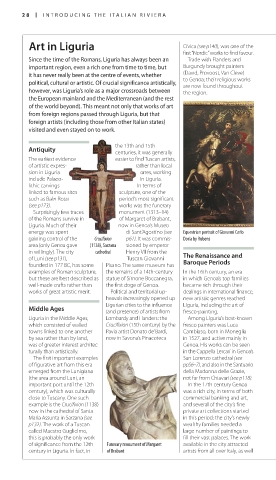
energy was spent di Sant’Agostino (see Equestrian portrait of Giovanni Carlo
gaining control of the Crucifixion p61). It was commis Doria by Rubens
area (only Genoa gave (1138), Sarzana sioned by emperor
in willingly). The city cathedral Henry VII from the
of Luni (see p131), Tuscan Giovanni The Renaissance and
Baroque Periods
founded in 177 BC, has some Pisano. The same museum has
examples of Roman sculpture, the remains of a 14thcentury In the 16th century, an era
but these are best described as statue of Simone Boccanegra, in which Genoa’s top families
wellmade crafts rather than the first doge of Genoa. became rich through their
works of great artistic merit. Political and territorial up dealings in international finance,
heavals increasingly opened up new artistic genres reached
Ligurian cities to the influence Liguria, including the art of
Middle Ages
(and presence) of artists from frescopainting.
Liguria in the Middle Ages, Lombardy and Flanders: the Among Liguria’s bestknown
which consisted of walled Crucifixion (15th century) by the fresco painters was Luca
towns linked to one another Pavia artist Donato de’ Bardi, Cambiaso, born in Moneglia
by sea rather than by land, now in Savona’s Pinacoteca in 1527, and active mainly in
was of greater interest architec Genoa. His works can be seen
turally than artistically. in the Cappella Lercari in Genoa’s
The first important examples San Lorenzo cathedral (see
of figurative art from this era pp56–7), and also in the Santuario
emerged from the Lunigiana della Madonna delle Grazie,
(the area around Luni, an not far from Chiavari (see p118).
important port until the 12th In the 17th century Genoa
century), which was culturally was a rich city, in terms of both
close to Tuscany. One such commercial banking and art,
example is the Crucifixion (1138) and several of the city’s fine
now in the cathedral of Santa private art collections started
Maria Assunta in Sarzana (see in this period: the city’s newly
p132). The work of a Tuscan wealthy families needed a
called Maestro Guglielmo, large number of paintings to
this is probably the only work fill their vast palaces. The work
of significance from the 12th Funerary monument of Margaret available in the city attracted
century in Liguria. In fact, in of Brabant artists from all over Italy, as well
028-029_EW_Italian_Riviera.indd 28 09/09/16 10:46 am

