


Page 32 - (DK Eyewitness) Travel Guide - Italian Riviera
P. 32
30 INTRODUCING THE IT ALIAN RIVIER A
Architecture in Liguria
The truly creative expressions in Liguria’s past lie less with
art, or sculpture, than in the people’s exceptional capacity to
adapt their buildings to the contours of an often harsh and
difficult landscape. Perched above the sea and hemmed in
by the Apennines, the cities of the Italian Riviera developed
in a totally individual way. In Genoa, in particular, the
defining characteristic of the city was as a meeting point
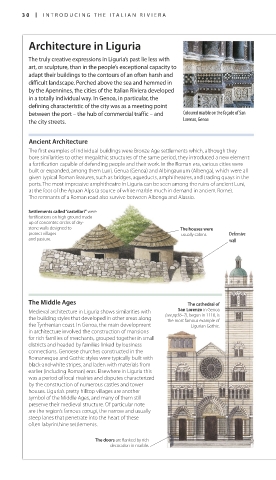
between the port – the hub of commercial traffic – and Coloured marble on the façade of San
the city streets. Lorenzo, Genoa
Ancient Architecture
The first examples of individual buildings were Bronze Age settlements which, although they
bore similarities to other megalithic structures of the same period, they introduced a new element:
a fortification capable of defending people and their work. In the Roman era, various cities were
built or expanded, among them Luni, Genua (Genoa) and Albingaunum (Albenga), which were all
given typical Roman features, such as bridges, aqueducts, amphitheatres, and trading quays in the
ports. The most impressive amphitheatre in Liguria can be seen among the ruins of ancient Luni,
at the foot of the Apuan Alps (a source of white marble much in demand in ancient Rome).
The remnants of a Roman road also survive between Albenga and Alassio.
Settlements called “castellari” were
fortifications on high ground made
up of concentric circles of dry-
stone walls designed to The houses were
protect villages usually cabins. Defensive
and pasture. wall
The Middle Ages The cathedral of
San Lorenzo in Genoa
Medieval architecture in Liguria shows similarities with (see pp56–7), begun in 1118, is
the building styles that developed in other areas along the most famous example of
the Tyrrhenian coast. In Genoa, the main development Ligurian Gothic.
in architecture involved the construction of mansions
for rich families of merchants, grouped together in small
districts and headed by families linked by business
connections. Genoese churches constructed in the
Romanesque and Gothic styles were typically built with
black-and-white stripes, and laden with materials from
earlier (including Roman) eras. Elsewhere in Liguria this
was a period of local rivalries and disputes characterized
by the construction of numerous castles and tower
houses. Liguria’s pretty hilltop villages are another
symbol of the Middle Ages, and many of them still
preserve their medieval structure. Of particular note
are the region’s famous carrugi, the narrow and usually
steep lanes that penetrate into the heart of these
often labyrinthine settlements.
The doors are flanked by rich
decoration in marble.
030-031_EW_Italian_Riviera.indd 30 09/09/16 10:46 am

