


Page 65 - (DK Eyewitness) Travel Guide - Italian Riviera
P. 65
IL CENTRO ST ORIC O 63
in the 1800s), was required charming arcaded street was on a terrace and is reached by
because of the rise in power of designed so that its shops means of a scenic flight of steps.
the Banco di San Giorgio. The could make the most of their It has a central plan with an
bank administered the proceeds proximity to the buzzing port octagonal dome with three
from taxes collected by the area. Today, as it did in the pinnacles (four were originally
Republic and also ran the past, the street is home to shops planned). The façade bears
Republic’s colonies. It was selling various specialist food, frescoes by Giovanni Battista
responsible for much of Genoa’s and there are snack bars, too. Baiardo (c.1650), which were
prosperity in the 15th century. From here, Via al Ponte Reale restored in the 1990s.
Today, the palace houses the leads to Piazza Banchi, the
offices of the harbour authorities. commercial core of the city up
Inside, the Salone delle until the 18th century, and a
Compere is decorated with crucial crossroads of major lines
16th-century statues of the of communication between
Protettori del Banco (protectors the city and the port. By the
of the bank) and the Arms of Middle Ages there was already
Genoa with the symbols of Justice a thriving grain market in the
and Strength by Francesco De piazza, and moneychangers
Ferrari (1490–91). also set up their stalls here,
The Sala dei Protettori attracting merchants from all
features a monu mental hearth over the world – the piazza is
by Giovanni Giacomo Della named after the money-
Porta (1554). Visitors can also changers’ tables. Later, money-
see the Sala del Capitano del changers and other traders
Popolo, and the Manica Lunga, worked in the 16th-century
a 128 m (420 ft) long corridor Loggia dei Mercanti.
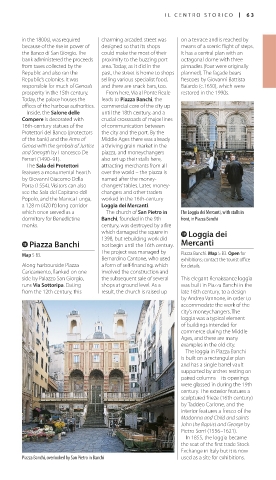
which once served as a The church of San Pietro in The Loggia dei Mercanti, with stalls in
dormitory for Benedictine Banchi, founded in the 9th front, in Piazza Banchi
monks. century, was destroyed by a fire
which damaged the square in o Loggia dei
1398, but rebuilding work did
i Piazza Banchi not begin until the 16th century. Mercanti
The project was managed by
Map 5 B3. Piazza Banchi. Map 5 B3. Open for
Bernardino Cantone, who used exhibitions; contact the tourist office
Along harbourside Piazza a form of self-financing, which for details.
Caricamento, flanked on one involved the construction and
side by Palazzo San Giorgio, the subsequent sale of several This elegant Renaissance loggia
runs Via Sottoripa. Dating shops at ground level. As a was built in Piazza Banchi in the
from the 12th century, this result, the church is raised up late 16th century, to a design
by Andrea Vannone, in order to
accommodate the work of the
city’s moneychangers. The
loggia was a typical element
of buildings intended for
commerce during the Middle
Ages, and there are many
examples in the old city.
The loggia in Piazza Banchi
is built on a rectangular plan
and has a single barrel vault
supported by arches resting on
paired columns – its openings
were glassed in during the 19th
century. The exterior features a
sculptured frieze (16th century)
by Taddeo Carlone, and the
interior features a fresco of the
Madonna and Child and saints
John the Baptist and George by
Pietro Sorri (1556–1621).
In 1855, the loggia became
the seat of the first trade Stock
Exchange in Italy but it is now
Piazza Banchi, overlooked by San Pietro in Banchi used as a site for exhibitions.
062-063_EW_Italian_Riviera.indd 63 09/09/16 10:47 am

