


Page 104 - (DK Eyewitness) Travel Guide - New Orleans
P. 104
102 NE W ORLEANS AREA B Y AREA
Street-by-Street: Garden District
When the Americans arrived in New Orleans, they settled
MID-CITY
upriver from the French Quarter. The plantations that QUARTER
FRENCH
lined St. Charles Avenue in the 1820s were sub divided WAREHOUSE
and the city of Lafayette established. It was incorporated DISTRICT
& CBD
into New Orleans in 1852. Today, this area is referred to as GARDEN DISTRICT
the Garden District, a residential neighborhood filled with AND UPTOWN
grand Victorian mansions built by wealthy city merchants M i ss is si pp i
and planters. The gardens, planted with magnolia, camellia,
sweet olive, jasmine, and azalea, are as stunning as the Locator Map
residences themselves. See Street Finder maps 6, 7, & 8
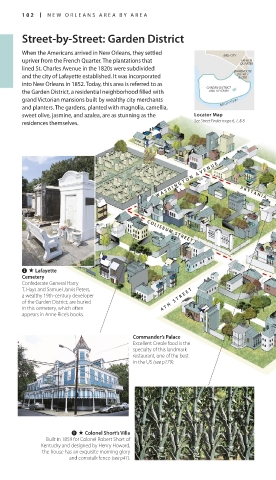
W A S H I N G T O N A V E N U E P R Y T A N I A S T R E E T
2 . Lafayette C O L I S E U M S T R E E T
Cemetery
Confederate General Harry
T. Hays and Samuel Jarvis Peters,
a wealthy 19th-century developer
of the Garden District, are buried 4 T H S T R E E T
in this cemetery, which often
appears in Anne Rice’s books.
Commander’s Palace
Excellent Creole food is the
specialty of this landmark
restaurant, one of the best
in the US (see p179).
q . Colonel Short’s Villa
Built in 1859 for Colonel Robert Short of
Kentucky and designed by Henry Howard,
the house has an exquisite morning glory
and cornstalk fence (see p41).
102-103_EW_New_Orl.indd 102 05/08/16 3:49 pm
Eyewitness Travel LAYERS PRINTED:
Starsight template “UK” LAYER
(Source v2.7)
Date 24th April 2013
Size 125mm x 217mm

