


Page 107 - (DK Eyewitness) Travel Guide - New Orleans
P. 107
GARDEN DISTRIC T AND UPT OWN 105
a passenger elevator, and a
magnificent circular staircase.
It is one of the few houses in
the city to have a basement.
Since 1929, it has served
as a private school for girls.
The cafeteria was once a
stable, and the gym is a
refurbished carriage house.
Note the steep mansard roof
with its wrought-iron parapet
and the unique bull’s-eye
window on the facade.
The gardens contain some
magnificent magnolias and
Gothic arched windows, Briggs-Staub House ginger trees.
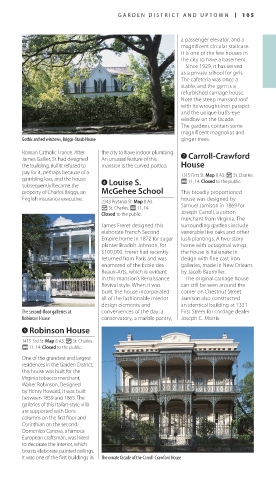
Roman Catholic France. After the city to have indoor plumbing. 7 Carroll-Crawford
James Gallier, Sr. had designed An unusual feature of this
the building, Bullitt refused to mansion is the curved portico. House
pay for it, perhaps because of a 1315 First St. Map 8 A3. v St. Charles.
gambling loss, and the house 6 Louise S. @ 11, 14. Closed to the public.
subsequently became the
property of Charles Briggs, an McGehee School This broadly proportioned
English insurance executive. house was designed by
2343 Prytania St. Map 8 A3.
v St. Charles. @ 11, 14. Samuel Jamison in 1869 for
Closed to the public. Joseph Carroll, a cotton
merchant from Virginia. The
James Freret designed this surrounding gardens include
elaborate French Second venerable live oaks and other
Empire home in 1872 for sugar lush plantings. A two-story
planter Bradish Johnson, for home with octagonal wings,
$100,000. Freret had recently the house is Italianate in
returned from Paris and was design with fine cast-iron
enamored of the École des galleries, made in New Orleans
Beaux-Arts, which is evident by Jacob Baumiller.
in this mansion’s Renaissance The original carriage house
Revival style. When it was can still be seen around the
built, the house incorporated corner on Chestnut Street.
all of the fashionable interior Jamison also constructed
design elements and an identical building at 1331
The second-floor galleries at conveniences of the day: a First Street for cordage dealer
Robinson House conservatory, a marble pantry, Joseph C. Morris.
5 Robinson House
1415 3rd St. Map 8 A3. v St. Charles.
@ 11, 14. Closed to the public.
One of the grandest and largest
residences in the Garden District,
this house was built for the
Virginia tobacco merchant,
Walter Robinson. Designed
by Henry Howard, it was built
between 1859 and 1865. The
galleries of this Italian-style villa
are supported with Doric
columns on the first floor and
Corinthian on the second.
Domenico Canova, a famous
European craftsman, was hired
to decorate the interior, which
boasts elaborate painted ceilings.
It was one of the first buildings in The ornate facade of the Carroll-Crawford House
104-105_EW_New_Orl.indd 105 05/08/16 3:49 pm

