


Page 138 - (DK Eyewitness) Travel Guide - New Orleans
P. 138
136 NE W ORLEANS AREA B Y AREA
A 90-Minute Walk Around the Faubourg St. John
This walk circles a portion of Bayou St. John, an historically
strategic waterway where some of the city’s earliest colonial
development took place. It also showcases a beautiful
residential neighborhood with original Creole mansions and
the distinctive above-ground St. Louis Cemetery #3. The area
is easily accessible from downtown via the Canal streetcar and
is close to the attractions in City Park (see pp118–19).
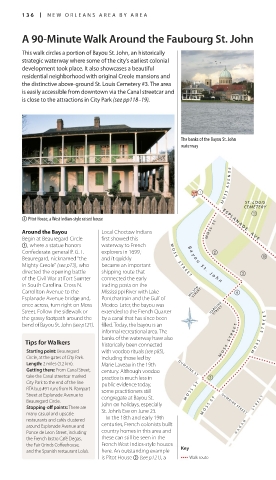
The banks of the Bayou St. John
waterway
A V E N U E
M O S S ST. LOUIS
1
CEMETERY
q
2 Pitot House, a West Indian-style raised house E S P L A N A D E A V E
Around the Bayou Local Choctaw Indians M O S S S T
Begin at Beauregard Circle first showed this
1, where a statue honors waterway to French
Confederate general P. G. T. explorers in 1699, M O S S B a 2 9
Beauregard, nicknamed “the and it quickly 0
Mighty Creole” (see p73), who became an important y o u S t . J o h n M Y S T E R Y S T R E E T
directed the opening battle shipping route that S T R E E T 3
of the Civil War at Fort Sumter connected the early M A U R E P A S S T R E E T
in South Carolina. Cross N. trading posts on the
Carrollton Avenue to the Mississippi River with Lake WILSON STREET 4
Esplanade Avenue bridge and, Pontchartrain and the Gulf of 8 P O N C E D E L E O N S T R E E T
once across, turn right on Moss Mexico. Later, the bayou was HARDING
Street. Follow the sidewalk or extended to the French Quarter STREET T G R A N D R O U T E E S P L A N A D E A V E N U E
S T J O H N
the grassy footpath around the by a canal that has since been E E
bend of Bayou St. John (see p121). filled. Today, the bayou is an T R
informal recreational area. The S T D E S O T O S T R E E T S T R E E T 7
banks of the waterway have also S
Tips for Walkers historically been connected M O S S S T R E E S
Starting point: Beauregard with voodoo rituals (see p85), M O H A G A N S T
Circle, at the gates of City Park. including those led by N . R E N D O N N . L O P E Z S T R E E T D E S O T O S T
Length: 2 miles (3.2 km). Marie Laveau in the 19th
Getting there: From Canal Street, century. Although voodoo D U M A I N E S T
take the Canal streetcar marked practice is much less in 5
City Park to the end of the line. public evidence today, U R S U L I N E S A V E N U E
RTA bus #91 runs from N. Rampart some practitioners still M O S S S T 6 B E L L S T R E E T
Street at Esplanade Avenue to congregate at Bayou St. KENNEDY
Beauregard Circle. D U M A I N E S T R E E T PLACE
Stopping-off points: There are John on holidays, especially M O S S S T S T . P H I L I P S T R E E T
many casual and upscale St. John’s Eve on June 23. H A G A N S T R E E T
restaurants and cafés clustered In the 18th and early 19th
around Esplanade Avenue and centuries, French colonists built
Ponce de Leon Street, including country homes in this area and
the French bistro Café Degas, these can still be seen in the
the Fair Grinds Coffeehouse, French West Indies-style houses Key
and the Spanish restaurant Lola’s. here. An outstanding example
is Pitot House 2 (see p121), a Walk route
136-137_EW_New_Orl.indd 136 05/08/16 3:49 pm
Eyewitness Travel LAYERS PRINTED:
Catalogue template “UK” LAYER
(Source v2.7)
Date 1st October 2013
Size 125mm x 217mm

