


Page 139 - (DK Eyewitness) Travel Guide - New Orleans
P. 139
THREE GUIDED W ALKS 137
Creole raised country house
that is now a museum.
Named for James Pitot, New
Orleans’ first American mayor,
construction of the house
started in 1799. It is filled
with period antiques, and
offers a glimpse of life in early
19th-century New Orleans.
Next to Pitot House is Cabrini
High School 3, a private school
named for Mother Frances
Cabrini who had originally
established an orphanage
on the spot in 1905. Mother
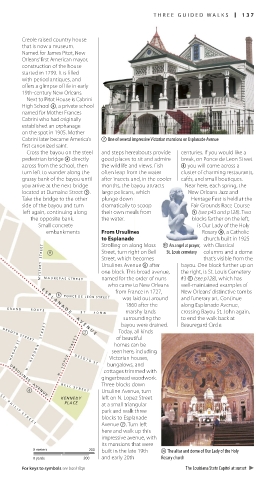
Cabrini later became America’s 7 One of several impressive Victorian mansions on Esplanade Avenue
first canonized saint.
Cross the bayou on the steel and steps here abouts provide centuries. If you would like a
pedestrian bridge 4 directly good places to sit and admire break, on Ponce de Leon Street
across from the school, then the wildlife and views. Fish 8 you will come across a
A V E N U E turn left to wander along the often leap from the water cluster of charming restaurants,
cafés, and small boutiques.
after insects and, in the cooler
grassy bank of the bayou until
M O S S ST. LOUIS Take the bridge to the other plunge down Heritage Fest is held at the
located at Dumaine Street 5.
large pelicans, which
New Orleans Jazz and
1 you arrive at the next bridge months, the bayou attracts Near here, each spring, the
CEMETERY side of the bayou and turn dramatically to scoop Fair Grounds Race Course
q left again, continuing along their own meals from 9 (see p43 and p128). Two
the opposite bank.
blocks farther on the left,
the water.
M O S S S T E S P L A N A D E A V E Small concrete From Ursulines is Our Lady of the Holy
Rosary 0, a Catholic
embankments
to Esplanade
church built in 1925
M Y S T E R Y S T R E E T Ursulines Avenue 6 after bayou. One block further up on
St. Louis cemetery
Street, turn right on Bell
columns and a dome
2 9 Strolling on along Moss q An angel at prayer, with Classical
B a
0 Street, which becomes that’s visible from the
M O S S
3 M A U R E P A S S T R E E T one block. This broad avenue, the right, is St. Louis Cemetery
#3 q (see p128), which has
named for the order of nuns
S T R E E T
y o u S t . J o h n
who came to New Orleans well-maintained examples of
WILSON STREET 4 8 P O N C E D E L E O N S T R E E T from France in 1727, New Orleans’ distinctive tombs
was laid out around
and funerary art. Continue
HARDING T G R A N D R O U T E E S P L A N A D E A V E N U E 1860 after the along Esplanade Avenue,
STREET
marshy lands
crossing Bayou St. John again,
E S T J O H N surrounding the to end the walk back at
E
T S T R S T R E E T Today, all kinds Beauregard Circle.
bayou were drained.
M O S S S T R E E M O S S D E S O T O S T R E E T N . L O P E Z S T R E E T D E S O T O S T Victorian houses,
7
of beautiful
H A G A N S T
N . R E N D O N
homes can be
seen here, including
bungalows, and
cottages trimmed with
D U M A I N E S T
5 U R S U L I N E S A V E N U E gingerbread woodwork.
M O S S S T 6 KENNEDY Three blocks down
Ursuline Avenue, turn
B E L L S T R E E T
M O S S S T D U M A I N E S T R E E T S T . P H I L I P S T R E E T PLACE at a small triangular
left on N. Lopez Street
H A G A N S T R E E T
park and walk three
blocks to Esplanade
Avenue 7. Turn left
here and walk up this
impressive avenue, with
its mansions that were
0 meters 200 built in the late 19th 0 The altar and dome of Our Lady of the Holy
0 yards 200 and early 20th Rosary church
For keys to symbols see back flap The Louisiana State Capitol at sunset
136-137_EW_New_Orl.indd 137 05/08/16 3:49 pm

