


Page 77 - (DK Eyewitness) Travel Guide - New Orleans
P. 77
L OWER FRENCH QU AR TER , M ARIGN Y , AND TREME 75
the US, Benjamin Henry Latrobe
(1764–1820) was born in
England, and after working as a
professional architect for several
years in Europe, he came to the
United States in 1796. Latrobe
was highly influential, and built
a variety of private residences
and public buildings, the latter
ranging from waterworks
to cathedrals. He is largely
responsible for the interior of
the US Capitol Building, and
for the East Portico of the
White House. He died in New
Orleans of yellow fever while
supervising the building of Gauche Villa, with its superb original ironwork
a new waterworks.
adorns the balcony, cast in street cut through what was
Saarbrucken, Germany, and the most aristocratic Creole
0 Gauche Villa shipped to New Orleans. Rows neighborhood of impressive
of anthema and other Greek villas and townhouses. The
704 Esplanade Ave at Royal.
Map 5 D1. @ 5. v Riverfront. floral motifs decorate the edge fashionable elite paraded in
Closed to the public. of the roof and the fence posts. their carriages past the many
Architect James Freret designed elegant residences, some of
The beautiful ironwork of this the house for crockery merchant which have survived to this day.
residence is uniquely integral to John Gauche in 1856. Many of these homes were
the villa’s overall design, which designed by the city’s foremost
accounts for the building’s q Esplanade architects, including Henry
harmonious appearance. Little Howard, James Gallier, Sr., and
of the cast ironwork in New Avenue William and James Freret. Their
Orleans was constructed at the Maps 2 B2/C2–3 and 3 D3/E4. styles range from Greek Revival
same time as the building – @ 46, 48. to Italianate and Queen Anne.
mostly it was added as an Most are still private residences,
afterthought. Numerous Today, Esplanade Avenue acts but some have been converted
patterns are used on the fence, as the dividing line between the into handsome bed-and-
the gate, the balconies, and French Quarter and Faubourg breakfasts. A stroll along this
the parapet, casting lovely Marigny, and extends from the street will reveal over 190
shadows on the stucco exterior Mississippi to Bayou St. John. As homes that were built before
on sun-filled days. A bacchant early as the 1830s, this broad, 1900. Every block contains
surrounded by grapevines tree-lined 3-mile (2-km) long numerous architectural gems.
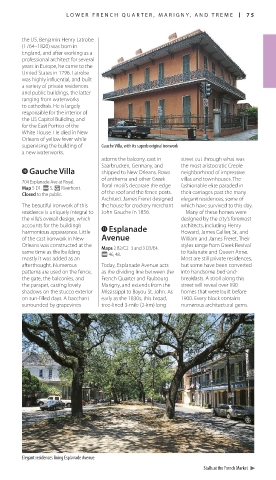
Elegant residences lining Esplanade Avenue
Stalls at the French Market
074-075_EW_New_Orl.indd 75 05/08/16 3:49 pm

