


Page 20 - History of War - Issue 25-16
P. 20
Frontline

         BATTLEOF73EASTING


          During Operation                      1. POISED TO STRIKE                  6. HASTY DEFENCE

          Desert Storm,                         The Coalition masses overwhelming force along the Iraqi-  As the Second Armored Cavalry Regiment pushes forward,
                                                Kuwaiti frontier for the ground phase of Desert Storm. The  small groups of Iraqi infantrymen attempt light resistance
          elements of the US-led                offensive will include a mechanised ‘left hook’ cutting off   with small-arms ire. These troops are occasionally supported
                                                Iraqi units from the west and a strike towards Kuwait City  by a tank or armoured vehicle, which is quickly destroyed. The
          Coalition’s VII Corps                 and the vital oil ields.             Iraqis typically surrender after iring a few rounds.
          destroyed two brigades                2. RETRIBUTION UNLEASHED             7. MORNING MANOEUVRE
                                                On 24 February 1991, following days of heavy aerial   Early on 26 February, elements of the Second Armored
          of the Iraqi Tawakalna                bombardment to soften up prepared Iraqi defences,   Cavalry Regiment defeat several companies of the Iraqi
          Division in combat                    the Coalition launches ground operations. The VII Corps   50th Brigade and receive orders to adjust its boundary with
                                                                                     the British First Armoured Division to the south, destroying
                                                breaches the Iraqi defensive line and begins a rapid
                                                advance towards the interior of the country.  an Iraqi T-72 tank subsequent to the manoeuvre.
               dvancing through southern Iraq towards
               the Kuwaiti border on 26 February  3. HAIL MARY                       8. BATTLE JOINED
          A 1991, the second day of the ground  In a manoeuvre that is nicknamed the ‘Hail Mary’, the VII   By late morning, a ierce sandstorm restricts visibility. All
          phase of Operation Desert Storm, the US  Corps races from its jump-off locations in Saudi Arabia   three squadrons of the Second Armored Cavalry Regiment
          Second Armored Cavalry Regiment brushed  with the mission of cutting off any Iraqi retreat from   engage the Tawakalna Division near 60 Easting. At noon,
          aside Iraqi tanks at 60 Easting, a location  Kuwait and destroying the capability of the Iraqi Army to   the Third Squadron reports destroying 23 Iraqi T-55 tanks,
          designating map co-ordinates in the trackless  wage war.                   25 armoured personnel carriers and other vehicles.
          desert. It then moved on to decimate the  4. LIGHT SPORADIC RESISTANCE     9. THROUGH 70 EASTING
          Iraqi 18th Mechanized and 37th Armored  Although the Coalition forces are prepared to engage   Although ordered to avoid a general engagement, the Second
          Brigades at 73 Easting. Along with elements  immediately in heavy combat, the initial advance   Armored Cavalry Regiment encounters increasing resistance
          of the British First Armoured Division, the  encounters only light resistance, and the offensive gains   as it moves from 60 Easting with eight of its nine cavalry
          American forces destroyed about 160 enemy  momentum rapidly. The Second Armored Cavalry Regiment  troops abreast. At approximately 3.45pm, Eagle Troop heads
          tanks and armoured vehicles, many of them  moves generally north-eastward as a scouting unit.  along 70 Easting, and the ight spreads southwards.
          the Soviet-built T-55, T-72 and BMP-1, during
          approximately 80 hours of intense ighting.  5. RAPID MOVEMENT              10. DECISION AT 73 EASTING
                                                On the leading edge of the north-eastward Coalition   Second and Third Squadrons, Second Armored Cavalry
          “12 EAGLE TROOP M1A1 TANKS            advance, the Second Armored Cavalry Regiment moves   Regiment, encounter tanks of the Tawakalna Division,
                                                                                     many located in prepared positions. Outnumbered three-
                                                forward rapidly with the intent of inding and ixing the
         DESTROY 28 IRAQI TANKS AND             Tawakalna Division of the Iraqi Republican Guard. The   to-one, they annihilate the Iraqis. 12 Eagle Troop M1A1
                                                regiment meets only sporadic enemy resistance along the
                                                                                     tanks destroy 28 Iraqi tanks and over 40 other vehicles in
         OVER 40 OTHER VEHICLES”                way, until 25 February.              less than 30 minutes.

                                                                   WITHIN MINUTES OF THE INITIAL EAGLE TROOP CONTACT
                                                                   WITH THE TAWAKALNA DIVISION, MORE SECOND
          CAVALRYTROOPSCLOSEIN ARMORED CAVALRY REGIMENT FORCES CONVERGE
           From the time that the Battle of 73 Easting was joined, visibility
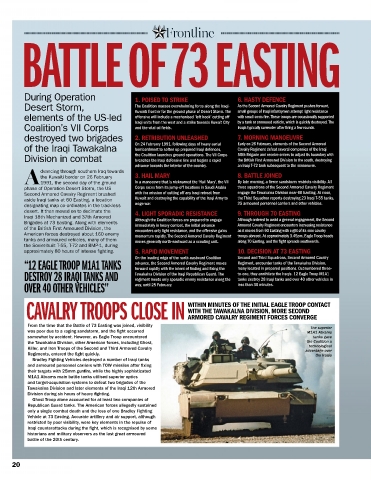
                                                                                                              The superior
           was poor due to a raging sandstorm, and the ight occurred                                         M1A1 Abrams
           somewhat by accident. However, as Eagle Troop encountered                                           tanks gave
           the Tawakalna Division, other American forces, including Ghost,                                   the Coalition a
                                                                                                              technological
           Killer, and Iron Troops of the Second and Third Armored Cavalry
                                                                                                            advantage over
           Regiments, entered the ight quickly.                                                                 the Iraqis
            Bradley Fighting Vehicles destroyed a number of Iraqi tanks
           and armoured personnel carriers with TOW missiles after ixing
           their targets with 25mm gunire, while the highly sophisticated
           M1A1 Abrams main battle tanks utilised superior optics
           and target-acquisition systems to defeat two brigades of the
           Tawakalna Division and later elements of the Iraqi 12th Armored
           Division during six hours of heavy ighting.
            Ghost Troop alone accounted for at least two companies of
           Republican Guard tanks. The American forces allegedly sustained
           only a single combat death and the loss of one Bradley Fighting
           Vehicle at 73 Easting. Accurate artillery and air support, although
           restricted by poor visibility, were key elements in the repulse of
           Iraqi counterattacks during the ight, which is recognised by some
           historians and military observers as the last great armoured
           battle of the 20th century.


     20

