


Page 16 - History of War - Issue 25-16
P. 16
Frontline


               ANATOMY OF A  The British Army’s Challenger 2 is one of the most


                 sophisticated weapons of its kind


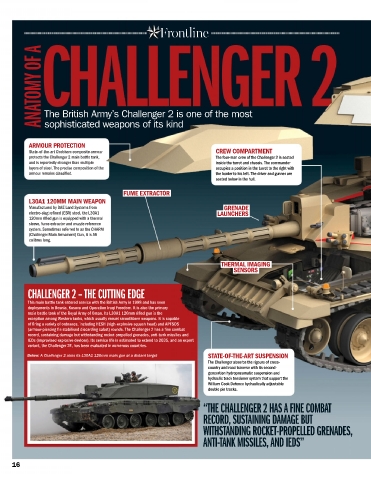
                                                                             CREW COMPARTMENT
                                                                             The four-man crew of the Challenger 2 is seated
                                                                             inside the turret and chassis. The commander
                                                                             occupies a position in the turret to the right with
                                                                             the loader to his left. The driver and gunner are
                                                                             seated below in the hull.

                                            FUME EXTRACTOR

                                                                                GRENADE
                                                                             LAUNCHERS


                                                                               THERMAL IMAGING
                                                                                   SENSORS


           CHALLENGER 2 – THE CUTTING EDGE

           This main battle tank entered service with the British Army in 1998 and has seen
           deployments in Bosnia, Kosovo and Operation Iraqi Freedom. It is also the primary
           main battle tank of the Royal Army of Oman. Its L30A1 120mm ril ed gun is the
           exception among Western tanks, which usually mount smoothbore weapons. It is capable
           of i ring a variety of ordnance, including HESH (high-explosive squash head) and APFSDS
           (armour-piercing i n stabilised discarding sabot) rounds. The Challenger 2 has a i ne combat
           record, sustaining damage but withstanding rocket-propelled grenades, anti-tank missiles and
           IEDs (improvised explosive devices). Its service life is estimated to extend to 2035, and an export
           variant, the Challenger 2E, has been evaluated in numerous countries.

           Below: A Challenger 2 aims its L30A1 120mm main gun at a distant target  STATE-OF-THE-ART SUSPENSION
                                                                          The Challenger absorbs the rigours of cross-
                                                                          country and road traverse with its second-
                                                                          generation hydropneumatic suspension and
                                                                          hydraulic track tensioner system that support the
                                                                          William Cook Defence hydraulically adjustable
                                                                          double pin tracks.

                                                                        “THE CHALLENGER 2 HAS A FINE COMBAT

                                                                        RECORD, SUSTAINING DAMAGE BUT
                                                                        WITHSTANDING ROCKET-PROPELLED GRENADES,

                                                                        ANTI-TANK MISSILES, AND IEDS”


     16

