


Page 36 - BBC Wildlife Volume 36 #12
P. 36
LONG-EARED OWLS


                                      ith its chameleon-
                                      like ability to meld
                                      perfectly into a
                                      background of bark
                                      and foliage, the
                                      long-eared owl is
           Wpossibly one of the
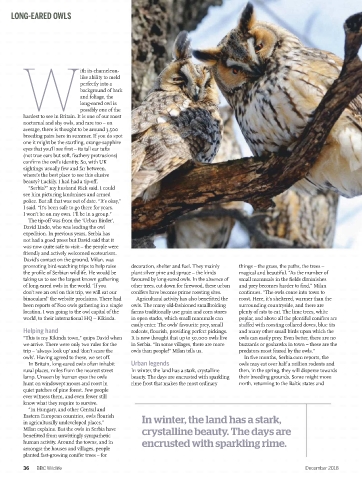
            hardest to see in Britain. It is one of our most
            nocturnal and shy owls, and rare too – on
            average, there is thought to be around 3,500
            breeding pairs here in summer. If you do spot
            one it might be the startling, orange-sapphire
            eyes that you’ll see first – its tall ear tufts
            (not true ears but soft, feathery protrusions)
            confirm the owl’s identity. So, with UK
            sightings usually few and far between,
            where’s the best place to see this elusive
            beauty? Luckily, I had had a tip-off.
              “Serbia?” my husband Rick said. I could
            see him picturing landmines and armed
            police. But all that was out of date. “It’s okay,”
            I said. “It’s been safe to go there for years.
            I won’t be on my own. I’ll be in a group.”
              The tip-off was from the 'Urban Birder’,
            David Lindo, who was leading the owl
            expedition. In previous years, Serbia has
            not had a good press but David said that it
            was now quite safe to visit – the people were
            friendly and actively welcomed ecotourism.
            David’s contact on the ground, Milan, was
            promoting bird-watching trips to help raise       decoration, shelter and fuel. They mainly        things – the grass, the paths, the trees –
            the profile of Serbian wildlife. He would be       plant silver pine and spruce – the kinds         magical and beautiful. “As the number of
            taking us to see the largest known gathering      favoured by long-eared owls. In the absence of   small mammals in the fields diminishes
            of long-eared owls in the world. ‘If you          other trees, cut down for firewood, these urban   and prey becomes harder to find,” Milan
            don’t see an owl on this trip, we will eat our    conifers have become prime roosting sites.       continues. “The owls come into town to
            binoculars!’ the website proclaims. There had       Agricultural activity has also benefitted the   roost. Here, it’s sheltered, warmer than the
            been reports of 800 owls gathering in a single    owls. The many old-fashioned smallholding        surrounding countryside, and there are
            location. I was going to the owl capital of the   farms traditionally use grain and corn stores    plenty of rats to eat. The lime trees, white
            world, to their international HQ – Kikinda.       in open stacks, which small mammals can          poplar, and above all the plentiful conifers are
                                                              easily enter. The owls’ favourite prey, small    stuffed with roosting collared doves, blue tits
            Helping hand                                      rodents, flourish, providing perfect pickings.    and many other small birds upon which the

            “This is my Kikinda town,” quips David when       It is now thought that up to 30,000 owls live    owls can easily prey. Even better, there are no
            we arrive. There were only two rules for the      in Serbia. “In some villages, there are more     buzzards or goshawks in town – these are the
            trip – ‘always look up’ and ‘don’t scare the      owls than people!” Milan tells us.               predators most feared by the owls.”
            owls’. Having agreed to these, we set off.                                                            In five months, Serbia.com reports, the
              In Britain, long-eared owls often inhabit       Urban legends                                    owls may eat over half a million rodents and
            rural places, miles from the nearest street       In winter, the land has a stark, crystalline     then, in the spring, they will disperse towards
            lamp. Unseen by human eyes the owls               beauty. The days are encrusted with sparkling    their breeding grounds. Some might move
            hunt on windswept moors and roost in              rime frost that makes the most ordinary          north, returning to the Baltic states and
            quiet patches of pine forest. Few people
            ever witness them, and even fewer still
            know what they require to survive.
              “In Hungary, and other Central and
            Eastern European countries, owls flourish
            in agriculturally undeveloped places,”                In winter, the land has a stark,
            Milan explains. But the owls in Serbia have           crystalline beauty. The days are
            benefitted from unwittingly sympathetic
            human activity. Around the towns, and in              encrusted with sparkling rime.
            amongst the houses and villages, people
            planted fast-growing conifer trees – for


            36    BBC Wildlife                                                                                                                December 2018

