


Page 13 - History of War - Issue 05-14
P. 13
DID CONCRETE OR LEAD CAUSE THE News in Brief
DEMISE OF THE ROMAN EMPIRE?
Scientists debate whether it was poison or construction that prompted downfall GREAT SCOT! SHACK UP WITH
ROBERT THE BRUCE IN PERTHSHIRE
he popular theory that lead If you’re a fan of Scottish history
contaminated the water in the and are planning on a wee break
Tcity of Rome, poisoning the this summer, the Cromlix hotel in
residents and bringing down the Empire, Perthshire might be the perfect
may not be entirely accurate. destination. Tennis ace Andy Murray,
The Proceedings of the National who bought the hotel for £1.8million
Academy of Sciences journal recently last February, personally named all
published a study on lead in Ancient 15 rooms after famous Scots. And he
Rome’s waters. Samples of water taken reserved Robert the Bruce, the Scots
from the Roman harbour basin at Portus, King who defeated the English 700
an industrious port in imperial Rome, years ago at Bannockburn, for one
were found to contain 100 times as of the hotel’s most impressive suites.
much lead as water from nearby springs.
However, while these levels were high, they CITY HALL RETURNED
were probably still not enough to bring TO ITS FORMER GLORY
about the downfall of the civilisation. An historic building in Sarajevo, the
Francis Albarède, head of the study at capital of Bosnia and Herzegovina,
Claude Bernard University, Lyon, said, “It’s downfall, weakening the city’s political and redeveloped the Ovile so that citizens has been restored to mark the
marginal. You would start being worried system, with Julius Caesar and Pompey – could vote. This was followed by various centenary of the start of the First
about drinking that water all your life.” Caesar’s main rival for leading the Roman projects, including a harbour at Ostia. World War. The City Hall, which was
Meanwhile, historian Dr Penelope Republic – competing over increasingly Says Davies, “What [Caesar] was converted into the National Library
Davies of the University of Texas believes impressive concrete structures. Pompey counting on is concrete. One could in 1949, went up in flames in 1992
that the rise in the use of concrete as a built the city’s first permanent theatre even say that it played a significant after being shelled by Serbs during
building material contributed to Rome’s in 55BC. Caesar then built a new forum role in bringing down the Republic.” a siege of the city. The neo-Moorish
structure is of significant historical
interest because Austrian Archduke
Franz Ferdinand was assassinated
HISTORY FAN COMMEMORATES soon after leaving a mayoral reception
there – an event that triggered
D-DAY WITH MILITARY TATTOO the start of hostilities in Europe.
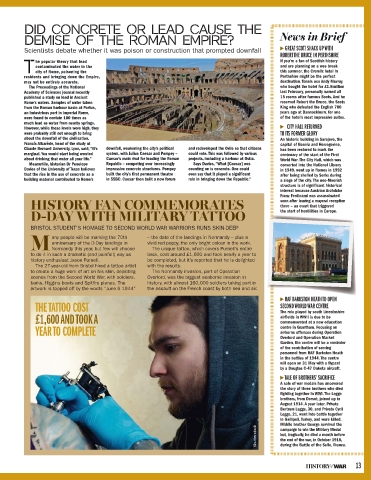
BRISTOL STUDENT’S HOMAGE TO SECOND WORLD WAR WARRIORS RUNS SKIN-DEEP
M – the date of the landings in Normandy – plus a
any people will be marking the 70th
anniversary of the D-Day landings in
vivid red poppy, the only bright colour in the work.
Normandy this year, but few will choose
The unique tattoo, which covers Purnell’s entire
to do it in such a dramatic (and painful!) way as back, cost around £1,600 and took nearly a year to
history enthusiast Jason Purnell. be completed, but it’s reported that he is delighted
The 27-year-old from Bristol hired a tattoo artist with the results.
to create a huge work of art on his skin, depicting The Normandy invasion, part of Operation
scenes from the Second World War, with soldiers, Overlord, was the biggest seaborne invasion in
tanks, Higgins boats and Spitfire planes. The history, with almost 160,000 soldiers taking part in
artwork is topped off by the words “June 6 1944” the assault on the French coast by both sea and air.
RAF BARKSTON HEATH TO OPEN
THE TATTOO COST SECOND WORLD WAR CENTRE
£1,600 AND TOOK A The role played by south Lincolnshire
airfields in WWII is due to be
commemorated at a new education
YEAR TO COMPLETE centre in Grantham. Focusing on
airborne offences during Operation
Overlord and Operation Market
Garden, the centre will be a reminder
of the contribution of serving
personnel from RAF Barkston Heath
in the battles of 1944. The centre
will open on 31 May with a flypast
by a Douglas C-47 Dakota aircraft.
TALE OF BROTHERS’ SACRIFICE
A sale of war medals has uncovered
the story of three brothers who died
fighting together in WWI. The Legge
brothers, from Dorset, joined up in
August 1914. A year later, Private
Bertram Legge, 30, and Private Cyril
Legge, 21, went into battle together
in Gallipoli, Turkey, and were killed.
Middle brother George survived the
Shutterstock but, tragically, he died a month before
campaign to win the Military Medal
the end of the war, in October 1918,
during the Battle of the Selle, France.
HISTORY WAR 13
of

