


Page 126 - Complete Birds of Britain and Europe (DK - RSPB)
P. 126
BIRDS OF PREY
       Order Accipitriformes  Family Accipitridae    Species Neophron percnopterus
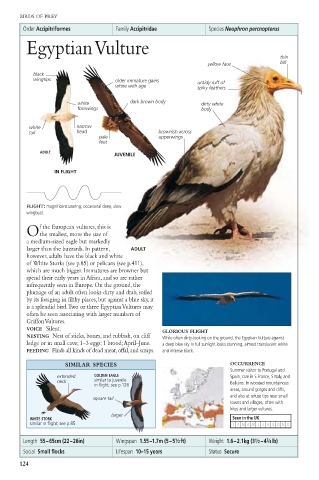
        Egyptian Vulture
                                                                       thin
                                                     yellow face       bill
         black
         wingtips             older immature gains  untidy ruff of
                              white with age
                                                  spiky feathers
                    white        dark brown body   dirty white
                    forewings                      body
        white       narrow
        tail        head                brownish across
                          pale          upperwings
                          feet
           ADULT
                             JUVENILE
               IN FLIGHT


        FLIGHT: magnificent soaring; occasional deep, slow
        wingbeat.
           f the European vultures, this is
        Othe smallest, more the size of
        a medium-sized eagle but markedly
        larger than the buzzards. In pattern,  ADULT
        however, adults have the black and white
        of White Storks (see p.85) or pelicans (see p.411),
        which are much bigger. Immatures are browner but
        spend their early years in Africa, and so are rather
        infrequently seen in Europe. On the ground, the
        plumage of an adult often looks dirty and drab, soiled
        by its foraging in filthy places, but against a blue sky, it
        is a splendid bird.Two or three Egyptian Vultures may
        often be seen associating with larger numbers of
        Griffon Vultures.
        VOICE Silent.                    GLORIOUS FLIGHT
        NESTING Nest of sticks, bones, and rubbish, on cliff  While often dirty-looking on the ground, the Egyptian Vulture against
        ledge or in small cave; 1–3 eggs; 1 brood;April–June.  a deep blue sky in full sunlight looks stunning, almost translucent white
        FEEDING Finds all kinds of dead meat,offal,and scraps.  and intense black.
                 SIMILAR SPECIES                          OCCURRENCE
                                                          Summer visitor to Portugal and
               extended  GOLDEN EAGLE                     Spain, rare in S France, S Italy, and
               neck     similar to juvenile               Balkans. In wooded mountainous
                        in flight; see p.126
                                                          areas, around gorges and cliffs,
                                                          and also at refuse tips near small
                        square tail
                                                          towns and villages, often with
                                                          kites and larger vultures.
                             larger
        WHITE STORK                                        Seen in the UK
        similar in flight; see p.85                        JF M A  M J  JA S ON D
       Length  55–65cm (22–26in)  Wingspan  1.55–1.7m (5–5 1 ⁄2ft)  Weight  1.6–2.1kg (3 1 ⁄2 –4 3 ⁄4lb)
       Social  Small flocks   Lifespan  10–15 years  Status  Secure
      124

