


Page 121 - Complete Birds of Britain and Europe (DK - RSPB)
P. 121
WILDFOWL
       Order Anseriformes     Family Anatidae        Species Oxyura jamaicensis
        Ruddy Duck                          dark cap on  dull grey-brown  blackish
                                                                     bill
                                            pale head
                                                       body
             all-dark            cheek stripe
             wings     dull dark grey-
                       brown body
                                                  dark
                    MALE                          grey
                    (SUMMER)                      bill
                                                    large, round  MALE (WINTER)
                                                    head
                                    FEMALE
                     white
            IN FLIGHT  face
                                      black cap             pure white
                                      and nape              cheeks
                               rounded
                         rufous  back
                         body
           stiff tail, laid                                  blue bill
           flat or angled
           upwards
                                                                 MALE
                                                                 (SUMMER)


        FLIGHT: fast, low, weak, with whirring wingbeats;
        direct, with little agility.
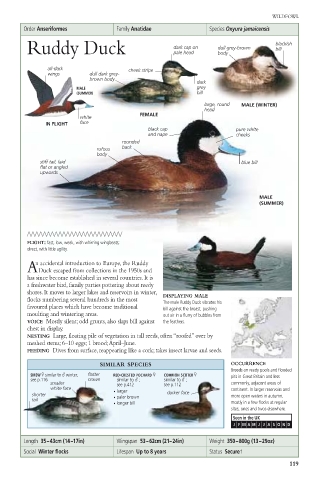
          n accidental introduction to Europe, the Ruddy
        ADuck escaped from collections in the 1950s and
        has since become established in several countries. It is
        a freshwater bird, family parties pottering about reedy
        shores. It moves to larger lakes and reservoirs in winter,  DISPLAYING MALE
        flocks numbering several hundreds in the most  The male Ruddy Duck vibrates his
        favoured places which have become traditional  bill against the breast, pushing
        moulting and wintering areas.     out air in a flurry of bubbles from
        VOICE Mostly silent; odd grunts, also slaps bill against  the feathers.
        chest in display.
        NESTING Large, floating pile of vegetation in tall reeds, often “roofed” over by
        meshed stems; 6–10 eggs; 1 brood;April–June.
        FEEDING Dives from surface, reappearing like a cork; takes insect larvae and seeds.
                          SIMILAR SPECIES                 OCCURRENCE
                                                          Breeds on reedy pools and flooded
         SMEW 2similar to 3winter;  flatter  RED-CRESTED POCHARD 2  COMMON SCOTER 2  pits in Great Britain and less
         see p.116     crown  similar to 3;  similar to 3;
              smaller         see p.412   see p.112       commonly, adjacent areas of
              white face                                  continent. In larger reservoirs and
                               larger      darker face
         shorter               paler brown                more open waters in autumn,
         tail
                               longer bill                mostly in a few flocks at regular
                                                          sites, ones and twos elsewhere.
                                                           Seen in the UK
                                                           J  F  M  A  M  JJ A S O  N  D
       Length  35–43cm (14–17in)  Wingspan  53–62cm (21–24in)  Weight  350–800g (13–29oz)
       Social  Winter flocks  Lifespan  Up to 8 years  Status  Secure†
                                                                         119

