


Page 60 - All About History - Issue 29-15
P. 60
The Truth Behind the Trojan War


           TheSearchForTroy


           ArcheologistshavescouredAnatoliainthehuntforthemythicalcity.After
           yearsofexcavationandspeculation,itmayhavebeenfound

           ThesearchforTroybeganin1871whenthe    and warships. But the Hellespont is not easy to
           Homer-loving German-American businessman  navigate. In addition to struggling against a strong
           Heinrich Schliemann began excavating a mound  current there, seafarers have to face a powerful
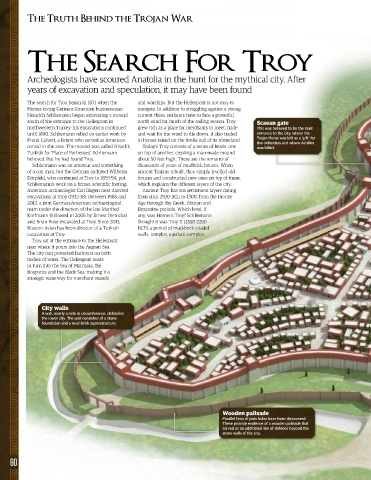
           southoftheentrancetotheHellespontin   north wind for much of the sailing season. Troy  Scaean gate
           northwestern Turkey; his excavations continued  grewrichasaplaceformerchantstomeet,trade  Thiswasbelievedtobethemain
           until 1890. Schliemann relied on earlier work by  andwaitforthewindtodiedown.Italsotraded  entrance to the city, where the
                                                                                           TrojanHorsewasleftasa‘gift’for
           FrankCalvert,aBritonwhoservedasAmerican  in horses raised on the fertile soil of its hinterland.
                                                                                           thedefendersandwhereAchilles
           consul in the area. The mound was called Hisarlik,  Today’sTroyconsistsofaseriesoflevels,one  was killed.
           Turkish for ‘Place of Fortresses’. Schliemann  on top of another, creating a man-made mound
           believed that he had found Troy.      about50feethigh.Thesearetheremainsof
            Schliemann was an amateur and something  thousandsofyearsofmudbrickhouses.When
           ofaconman,buttheGermanarchitectWilhelm  ancient Trojans rebuilt, they simply levelled old
           Dörpfeld, who continued at Troy in 1893-94, put  housesandconstructednewonesontopofthem,
           Schliemann’s work on a firmer, scientific footing.  whichexplainsthedifferentlayersofthecity.
           American archaeologist Carl Blegen next directed  AncientTroyhastensettlementlayersdating
           excavationsatTroy(1932-38).Between1988and  fromcirca2920BCEto1300,fromtheBronze
           2012,ajointGerman-Americanarchaeological  AgethroughtheGreek,Romanand
           team under the direction of the late Manfred  Byzantine periods. Which level, if
           Korfmann(followedin2005byErnestPernicka)  any,wasHomer’sTroy?Schliemann
           andBrianRoseexcavatedatTroy.Since2013,  thought it was Troy II (2550-2250
           RüstemAslanhasbeendirectorofaTurkish  BCE), a period of mud-brick citadel
           excavation at Troy.                   walls,temples,apalacecomplex
            TroysatattheentrancetotheHellespont,
           nearwhereitpoursintotheAegeanSea.
           Thecityhadprotectedharboursonboth
           bodiesofwater.TheHellespontleads
           in turn into the Sea of Marmara, the
           BosporusandtheBlackSea,makingita
           strategicwaterwayformerchantvessels


                City walls
                Awall,nearlyamileincircumference,defended
                thelowercity.Thewallconsistedofastone
                foundation and a mud-brick superstructure.


                                                                               Wooden palisade
                                                                               Parallel lines of post holes have been discovered.
                                                                               These provide evidence of a wooden palisade that
                                                                               served as an additional line of defence beyond the
                                                                               stone walls of the city.


     60

