


Page 63 - All About History - Issue 29-15
P. 63
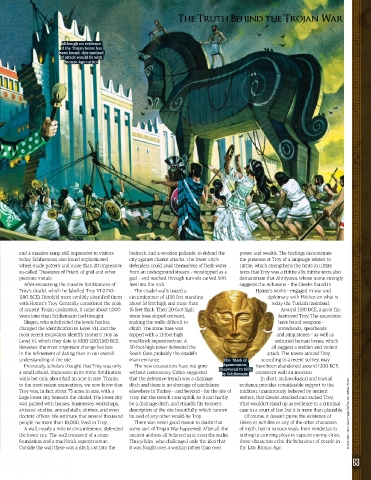
The Truth Behind the Trojan War


                       Although no evidence
                      of the Trojan horse has
                      been found, this method
                      of attack would fit with
                        Bronze-Age tactics


        and a massive ramp still impressive to visitors  bedrock, and a wooden palisade, to defend the  power and wealth. The findings demonstrate
        today. Schliemann also found sophisticated  city against chariot attacks. The lower city’s  thepresenceatTroyofalanguagerelatedto
        wheel-made pottery and more than 20 impressive  defenders could avail themselves of fresh water  Hittite, which strengthens the hints in Hittite
        so-called ‘Treasures of Priam’ of gold and other  from an underground stream – worshipped as a  texts that Troy was a Hittite ally. Hittite texts also
        precious metals.                       god–andreachedthroughtunnelscarved500  demonstrate that Ahhiyawa, whose name strongly
          After excavating the massive fortifications of  feet into the rock.        suggeststheAchaeans–theGreeksfoundin
        Troy’s citadel, which he labelled Troy VI (1740-  The citadel walls traced a       Homer’s works – engaged in war and
        1180 BCE), Dörpfeld more credibly identified them  circumferenceof1,150feetstandi       plomacywithHittitesonwhatis
        with Homer’s Troy. Generally considered the peak  about33feethighandmorethan             oday the Turkish mainland.
        of ancient Trojan civilisation, it came about 1,000  16 feet thick. Their 20-foot-high      Around 1180 BCE, a great fire
        years later than Schliemann had thought.  stonebaseslopedoutward,                          destroyed Troy. The excavators
          Blegen, who subdivided the levels further,  making the walls difficult to                have found weapons –
        changed the identification to Level VII, and the  climb. The stone base was                arrowheads, spearheads
        most recent excavators identify Homer’s Troy as  topped with a 13-foot-high               and sling stones – as well as
        Level VI, which they date to 1300-1210/1180 BCE.  mud-brick superstructure. A             unburied human bones, which
        However, the most important change lies less  30-foot-high tower defended the            ll suggest a sudden and violent
        in the refinement of dating than in our overall  South Gate, probably the citadel’s      ack. The towns around Troy,
        understanding of the site.             main entrance.                   The ‘Mask of     ding to a recent survey, may
          Previously, scholars thought that Troy was only  Thenewexcavationshavenotgone  Agamemnon’,  havebeenabandonedaround1200BCE,
                                                                              discovered in 1876
        a small citadel, impressive in its stone fortification  without controversy. Critics suggested  by Schliemann  consistent with an invasion.
        walls but only about half an acre in size. Thanks  that the defensive trench was a drainage  In short, archaeological and textual
        to the most recent excavations, we now know that  ditchandthereisnoshortageofcandidates  evidence provides considerable support to the
        Troy was, in fact, about 75 acres in size, with a  elsewhereinTurkey–andbeyond–forthesiteof  tradition, unanimously believed by ancient
        large lower city beneath the citadel. The lower city  Troy.Butthetrenchrunsuphill,soitcanhardly  writers, that Greeks attacked and sacked Troy.
        was packed with houses, businesses, workshops,  be a drainage ditch, and Hisarlik fits Homer’s  Thatwouldn’tstandupasevidenceinacriminal
        artisans’ studios, animal stalls, shrines, and even  descriptionofthesitebeautifully,whichcannot  caseinacourtoflaw,butitismorethanplausible.
        doctors’ offices. We estimate that several thousand  be said of any other would-be Troy.  Ofcourse,itdoesn’tprovetheexistenceof  © Adrian Mann, Alamy, Getty Images, Rex Features, Matthew Barrett
        people, no more than 10,000, lived in Troy.  Therewasnevergoodreasontodoubtthat  Helen or Achilles or any of the other characters
          A wall, nearlyamileincircumference,defended  some sort of Trojan War happened. After all, the  of myth, but in various ways, from vendettas to
        the lower city. The wall consisted of a stone  ancientauthorsallbelievedinit,eventherealist  raidingtocunningploystocaptureenemycities,
        foundation and a mud-brick superstructure.  Thucydides, who challenged only the idea that  thosecharactersechothebehaviourofpeoplein
        Outside the walltherewasaditch,cutintothe  itwasfoughtoverawomanratherthanover  theLateBronzeAge.
                                                                                                                             63

