


Page 69 - All About History - Issue 29-15
P. 69
Through History


                                                                         The cat might have
                                                                          got its name from   CAT O’ NINE TAILS  1695
                                                                         the scratches it left
                                                                          on a man’s back  The cat was a multi-thonged whip made infamous
                                                                                       by its use in the Royal Navy. Sailors were typically
                                                                                       flogged on deck in full sight of the watching
                                                                                       crew in order to emphasise to the watchers that
                                                                                        discipline must be maintained. The severity of
                                                                                          the punishment depended on exactly how
                                                                                             many lashes were ordered – too many and
                                                                                               a sailor might die as wounds became
                                                                                                  infected. Each cat was only used
                                                                                Tom
                                                                               Stacey                once; afterwards a new one was
                                                                             1930-PRESENT, BRITISH     made and placed in a red bag.
                                                                         In 1965, writer Tom Stacey was   Every sailor wanted to
                                                                        imprisoned in India while working as   avoid being the next
                                                                        a foreign correspondent. It sparked a   one who would let
                                                                       deep interest in the judicial system for
                                                                       the rest of his life. He was instrumental   the cat of the
                                                                        in persuading the British government        bag.
                                                                          to adopt electronic tagging in
                                                                           1999 – now 100,000 are
                                                                              used each year.
                                               ELECTRONIC TAG 1983
                              American prisons were
                              quick to adopt treadmills,   The electronic tag was designed to enfo
                              saying they could tame   arrest and aid rehabilitation, preventing
                              the most difficult of New   from moving more than a specified                    Electronic tags are
                                York’s prisoners                                                                often nicknamed
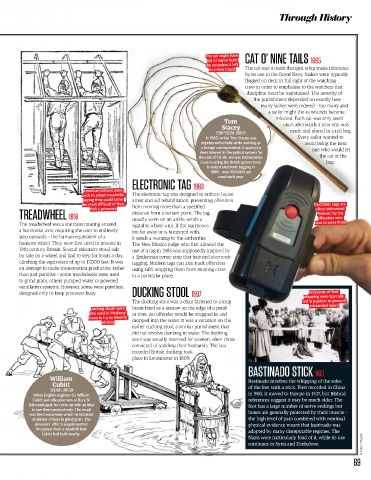
        TREADWHEEL  1818                       distance from a certain point. The tag,                          ‘Rolexes’ by the
                                                                                                                 offenders who
                                               usually worn on an ankle, sends a
        The treadwheel was a staircase rotating around   signal to a base unit. If the tag moves               have to wear them
        a horizontal axis, requiring the user to endlessly   too far away or is tampered with,
        step upwards – the human equivalent of a   it sends a warning to the authorities.
        hamster wheel. They were first used in prisons in   The New Mexico judge who first allow
        19th-century Britain. Several prisoners stood side   use of a tag in 1983 was supposedly ins
        by side on a wheel and had to step for hours a day,   a Spiderman comic strip that featured e
        climbing the equivalent of up to 17,000 feet. It was   tagging. Modern tags can also track offe
        an attempt to make incarceration productive, rather  using GPS, stopping them from straying
        than just punitive – some treadwheels were used   toaparticularplace.
        to grind grain, others pumped water or powered
        ventilation systems. However, some were pointless,
                                                                                                             Recipients of foot
        designed only to keep prisoners busy.  DUCKING STOOL  1597                                          whipping were typically
                                               The ducking stool was a chair fastened to a long            tied in position to prevent
                                 Ducking stools were   beam fixed as a seesaw on the edge of a pond          unintended injury
                                also used in Medieval   or river. An offender would be strapped in and
                                times to try to identify
                                     witches   dropped into the water. It was a variation on the
                                               earlier cucking stool, a similar punishment that
                                               did not involve dunking in water. The ducking
                                               stool was usually reserved for women, often those
                                               convicted of scolding their husbands. The last
                                               recorded British ducking took
                                               place in Leominster in 1809.

                                                                                        BASTINADO STICK  960
                   William                                                              Bastinado involves the whipping of the soles
                   Cubitt
                   1785-1861, BRITISH                                                   of the feet with a stick. First recorded in China
             When English engineer Sir William                                          in 960, it moved to Europe in 1537, but Biblical
            Cubitt saw idle prisoners at Bury St                                        references suggest it may be much older. The
           Edmunds gaol, he came up with an idea                                        foot has a large number of nerve endings but
            to use them productively. The result
           was the treadwheel, which he installed                                       bones are generally protected by thick muscle –
            at Brixton Prison to grind grain. The                                       the high level of pain combined with minimal
             prisoners’ efforts supplemented                                            physical evidence meant that bastinado was
              the power from a windmill that                                            adopted by many disreputable regimes. The
                Cubitt had built nearby.
                                                                                                                                © Alamy, Thinkstock
                                                                                        Nazis were particularly fond of it, while its use
                                                                                        continues in Syria and Zimbabwe.
                                                                                                                             69

