


Page 68 - All About History - Issue 29-15
P. 68
Through History


        PUNISHMENTS                                                                                         Frenchmen described


                                                                                                               19th-century
                                                                                                            caning as ‘the English
                                                                                                              vice’ due to its
        Pain, humiliation and rehabilitation: authorities have tried many                                    widespread use in
                                                                                                              English schools
        techniques over the cen


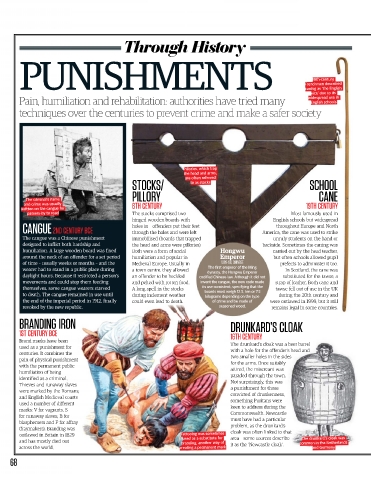
                                                                  Pillories, which trap
                                                                  the head and arms,
                                                                  are often referred
                                               STOCKS/              to as stocks                              SCHOOL
                                               PILLORY                                                           CANE
          The criminal’s name
         and crime was usually                 6TH CENTURY                                                   19TH CENTURY
        written on the cangue for
           passers-by to read                  The stocks comprised two                                Most famously used in
                                               hinged wooden boards with                         English schools but widespread
                                                                                                  throughout Europe and North
         CANGUE 2ND CENTURY BCE                holes in – offenders put their feet           America, the cane was used to strike
                                               through the holes and were left
         The cangue was a Chinese punishment   immobilised (boards that trapped                  unruly students on the hand or
         designed to inflict both hardship and   the head and arms were pillories).          backside. Sometimes the caning was
         humiliation. A large wooden board was fixed   Both were a form of social   Hongwu       carried out by the head teacher,
         around the neck of an offender for a set period   humiliation and popular in   Emperor   but often schools allowed pupil
         of time – usually weeks or months – and the   Medieval Europe. Usually in   1328-98, CHINESE  prefects to administer it too.
                                                                          The first emperor of the Ming
         wearer had to stand in a public place during   a town centre, they allowed   dynasty, the Hongwu Emperor   In Scotland, the cane was
         daylight hours. Because it restricted a person’s   an offender to be heckled   codified Chinese law. Although it did not   substituted for the tawse, a
         movements and could stop them feeding   and pelted with rotten food.   invent the cangue, the new code made   strap of leather. Both cane and
         themselves, some cangue wearers starved   A long spell in the stocks   its use consistent, specifying that the   tawse fell out of use in the UK
         to death. The cangue remained in use until   during inclement weather   boards must weigh 12.5, ten or 7.5   during the 20th century and
                                                                         kilograms depending on the type
         the end of the imperial period in 1912, finally   could even lead to death.  of crime and be made of   were outlawed in 1999, but it still
         revoked by the new republic.                                         seasoned wood.    remains legal in some countries.

        BRANDING IRON                                                             DRUNKARD’S CLOAK
        1ST CENTURY BCE                                                           16TH CENTURY
        Brand marks have been
                                                                                  The drunkard’s cloak was a beer barrel
        used as a punishment for
                                                                                  with a hole for the offender’s head and
        centuries. It combines the
                                                                                  two smaller holes in the sides
        pain of physical punishment
                                                                                  for the arms. Once suitably
        with the permanent public
                                                                                  attired, the miscreant was
        humiliation of being
                                                                                  paraded through the town.
        identified as a criminal.
                                                                                  Not surprisingly, this was
        Thieves and runaway slaves
                                                                                  a punishment for those
        were marked by the Romans,
                                                                                  convicted of drunkenness,
        and English Medieval courts
                                                                                  something Puritans were
        used a number of different
                                                                                  keen to address during the
        marks: V for vagrants, S
                                                                                  Commonwealth. Newcastle
        for runaway slaves, B for
                                                                                  must have had a particular
        blasphemers and F for affray
                                                                                  problem, as the drunkard’s
        (fraymakers). Branding was
        outlawed in Britain in 1829                              Tattooing was sometimes  cloak was often linked to that
                                                                 used as a substitute for   area – some sources describe   The drunkard’s cloak was
        and has mostly died out                                  branding, another way of                 common in the Netherlands
        across the world.                                       creating a permanent mark  it as the ‘Newcastle cloak’.  and Germany
     68

