


Page 147 - (DK Eyewitness) Travel Guide - Spain
P. 147
INTRODUCING BARCEL ONA 145
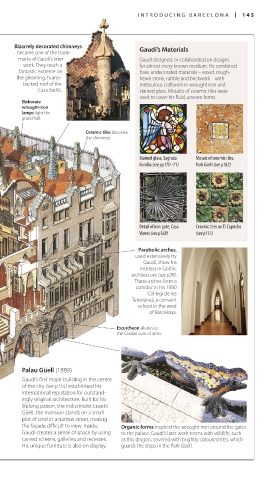
Bizarrely decorated chimneys Gaudí’s Materials
became one of the trade
marks of Gaudí’s later Gaudí designed, or collaborated on designs,
work. They reach a for almost every known medium. He com bined
fantastic extreme on bare, undecorated materials – wood, rough
the gleaming, hump hewn stone, rubble and brickwork – with
backed roof of the meticulous craftwork in wrought iron and
Casa Batlló. stained glass. Mosaics of ceramic tiles were
used to cover his fluid, uneven forms.
Elaborate
wrought-iron
lamps light the
grand hall.
Ceramic tiles decorate
the chimneys.
Stained glass, Sagrada Mosaic of ceramic tiles,
Família (see pp170–71) Park Güell (see p182)
Detail of iron gate, Casa Ceramic tiles on El Capricho
Vicens (see p168) (see p115)
Parabolic arches,
used extensively by
Gaudí, show his
interest in Gothic
architecture (see p28).
These arches form a
corridor in his 1890
Col·legi de les
Teresianes, a convent
school in the west
of Barcelona.
Escutcheon alludes to
the Catalan coat of arms.
Palau Güell (1889)
Gaudí’s first major building in the centre
of the city (see p155) established his
international reputation for outstand
ingly original architecture. Built for his
lifelong patron, the industrialist Eusebi
Güell, the mansion stands on a small
plot of land in a narrow street, making
the façade difficult to view. Inside, Organic forms inspired the wrought iron around the gates
Gaudí creates a sense of space by using to the palace. Gaudí’s later work teems with wildlife, such
carved screens, galleries and recesses. as this dragon, covered with brightly coloured tiles, which
His unique furniture is also on display. guards the steps in the Park Güell.
144-145_EW_Spain.indd 145 26/09/17 11:53 am

