


Page 152 - (DK Eyewitness) Travel Guide - Spain
P. 152
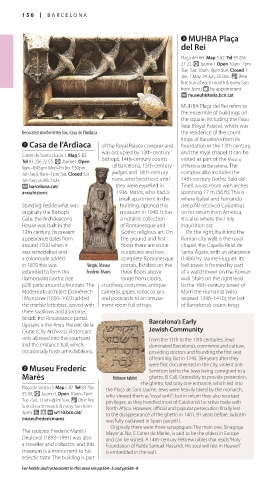
150 BARCEL ONA
3 MUHBA Plaça
del Rei
Plaça del Rei. Map 5 B2. Tel 93 256
21 22. Jaume I. Open 10am–7pm
Tue–Sat, 10am–8pm Sun. Closed 1
Jan, 1 May, 24 Jun, 25 Dec. & (free
first Sun of each month & every Sun
from 3pm.) 8 by appointment.
∑ museuhistoria.bcn.cat
MUHBA Plaça del Rei refers to
the ensemble of buildings on
the square, including the Palau
Reial (Royal Palace), which was
Decorated marble letterbox, Casa de l’Ardiaca the residence of the count-
kings of Barcelona from its
1 Casa de l’Ardiaca of the Royal Palace complex and foundation in the 13th century,
was occupied by 13th-century and the royal chapel. It can be
Carrer de Santa Llúcia 1. Map 5 B2.
Tel 93 256 22 55. Jaume I. Open bishops, 14th-century counts visited as part of the Museu
9am–8:45pm Mon–Fri (to 7:30pm of Barcelona, 15th-century d’Història de Barcelona. The
Jul–Sep), 9am–1pm Sat. Closed Sat judges and 18th-century complex also includes the
Jul–Sep, public hols. nuns, who lived here until 14th-century Gothic Saló del
∑ barcelona.cat/ they were expelled in Tinell, a vast room with arches
arxiuhistoric 1936. Marès, who had a spanning 17 m (56 ft). This is
small apart ment in the where Isabel and Fernando
Standing beside what was build ing, opened this (see p74) received Columbus
originally the Bishop’s museum in 1948. It has on his return from America.
Gate, the Archdeacon’s a notable collection It is also where the Holy
House was built in the of Romanesque and Inqui sition sat.
12th century. Its present Gothic religious art. On On the right, built into the
appearance dates from the ground and first Roman city wall, is the royal
around 1500 when it floors there are stone chapel, the Capella Reial de
was remodelled and sculp tures and two Santa Àgata, with an altarpiece
a colon nade added. complete Romanesque (1466) by Jaume Huguet. Its
In 1870 this was Virgin, Museu portals. Exhibits on the bell tower is formed by part
extended to form the Frederic Marès three floors above of a watch tower on the Roman
Flamboyant Gothic (see range from clocks, wall. Stairs on the right lead
p28) patio around a fountain. The crucifixes, costumes, antique to the 16th-century tower of
Modernista architect Domènech cameras, pipes, tobacco jars Martí the Humanist (who
i Montaner (1850–1923) added and postcards to an amuse- reigned 1396–1410), the last
the marble letterbox, carved with ment room full of toys. of Barcelona’s count-kings.
three swallows and a tortoise,
beside the Renaissance portal. Barcelona’s Early
Upstairs is the Arxiu Històric de la
Ciutat (City Archives). Visitors are Jewish Community
only allowed into the court yard From the 11th to the 13th centuries, Jews
and the entrance hall, which dominated Barcelona’s commerce and culture,
occasionally hosts art exhibitions. providing doctors and founding the first seat
of learning. But in 1243, 354 years after they
2 Museu Frederic were first documented in the city, violent anti-
Semitism led to the Jews being consigned to a
Marès Hebrew tablet ghetto, El Call. Ostensibly to provide protection,
the ghetto had only one entrance, which led into
Plaça de Sant Iu 5. Map 5 B2. Tel 93 256 the Plaça de Sant Jaume. Jews were heavily taxed by the monarch,
35 00. Jaume I. Open 10am–7pm who viewed them as “royal serfs”; but in return they also received
Tue–Sat, 11am–8pm Sun. & (free first privileges, as they handled most of Catalonia’s lucrative trade with
Sun of each month & every Sun from North Africa. However, official and popular persecution finally led
3pm). 7 9 ∑ w110.bcn.cat/ to the disappearance of the ghetto in 1401, 91 years before Judaism
museufredericmares was fully outlawed in Spain (see p61).
Originally there were three synagogues. The main one, Sinagoga
The sculptor Frederic Marès i Mayor at No. 5 Carrer de Marlet, is said to be the oldest in Europe
Deulovol (1893–1991) was also and can be visited. A 14th-century Hebrew tablet that reads “Holy
a traveller and collector, and this Foundation of Rabbi Samuel Hassardi, His soul will rest in Heaven”
museum is a monu ment to his is embedded in the wall.
eclectic taste. The building is part
For hotels and restaurants in this area see pp564–5 and pp586–8
150-151_EW_Spain.indd 150 26/09/17 11:00 am
Eyewitness Travel LAYERS PRINTED:
Catalogue template “UK” LAYER
(Source v2.1)
Date 5th December 2012
Size 125mm x 217mm

