


Page 166 - (DK Eyewitness) Travel Guide - Spain
P. 166
164 BARCEL ONA
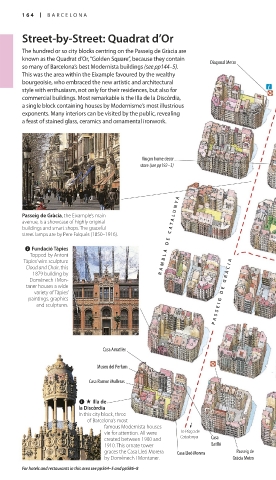
Street-by-Street: Quadrat d’Or
The hundred or so city blocks centring on the Passeig de Gràcia are
known as the Quadrat d’Or, “Golden Square”, because they contain Diagonal Metro
so many of Barcelona’s best Modernista buildings (see pp144–5).
This was the area within the Eixample favoured by the wealthy
bourgeoisie, who embraced the new artistic and architectural
style with enthusiasm, not only for their residences, but also for
commercial buildings. Most remarkable is the Illa de la Discòrdia,
a single block contain ing houses by Modernisme’s most illustrious
exponents. Many interiors can be visited by the public, revealing
a feast of stained glass, ceramics and ornamental ironwork.
Vinçon home decor
store (see pp192–3)
Y A
N
U
Passeig de Gràcia, the Eixample’s main L
avenue, is a show case of highly original A T A
buildings and smart shops. The graceful
street lamps are by Pere Falqués (1850–1916). C
E
D
2 Fundació Tàpies A
Topped by Antoni L
Tàpies’ wire sculpture M B A
Cloud and Chair, this A C I
1879 building by R À
Domènech i Mon G R
taner houses a wide E
variety of Tàpies’ D
paintings, graphics G
and sculptures. E I
S
S
P A CARRER DE VALÈNCIA
Casa Amatller
Museu del Perfum
Casa Ramon Mulleras
1 . Illa de
la Discòrdia
In this city block, three
of Barcelona’s most
famous Modernista houses
vie for attention. All were To Plaça de
created between 1900 and Catalunya Casa
1910. This ornate tower Batlló
graces the Casa Lleó Morera Casa Lleó Morera Passeig de
by Domènech i Montaner. Gràcia Metro
For hotels and restaurants in this area see pp564–5 and pp586–8
164-165_EW_Spain.indd 164 26/09/17 11:53 am

