


Page 161 - (DK Eyewitness) Travel Guide - Spain
P. 161
OLD T OWN 159
between 1715 and 1720 after a s Museu Martorell
13-month siege of the city. The Parc de la Ciutadella. Map 5 C3.
fortress was intended to house Tel 93 319 69 12. Arc de Triomf,
soldiers to keep law and order, Jaume I. Closed for renovations.
but was never used for this
purpose. Converted into a prison, Part of the Museu de Ciències
the citadel became notorious Naturals, the Museu Martorell
dur ing the Napoleonic occu- is Barcelona’s oldest museum.
pation (see p67) and, during the It opened in 1882 and was the
19th-century liberal repres sions, first building in the city to be
it was hated as a symbol of constructed expressly for the
centralized power. In 1878, under purpose of housing a museum.
General Prim, whose statue stands Beside it is the Hivernacle,
in the middle of the park, it was a glasshouse by Josep
pulled down and the park given Amargós, and the Umbracle,
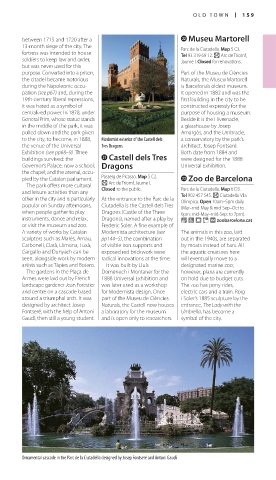
to the city, to become, in 1888, Modernist exterior of the Castell dels a conservatory by the park’s
the venue of the Universal Tres Dragons architect, Josep Fontseré.
Exhibition (see pp68–9). Three Both date from 1884 and
buildings survived: the a Castell dels Tres were designed for the 1888
Governor’s Palace, now a school; Dragons Universal Exhibition.
the chapel; and the arsenal, occu-
pied by the Catalan parliament. Passeig de Picasso. Map 5 C2. d Zoo de Barcelona
Arc de Triomf, Jaume I.
The park offers more cultural Closed to the public. Parc de la Ciutadella. Map 6 D3.
and leisure activities than any Tel 902 457 545. Ciutadella-Vila
other in the city and is particularly At the entrance to the Parc de la Olímpica. Open 10am–5pm daily
popular on Sunday afternoons, Ciutadella is the Castell dels Tres (Mar–mid-May & mid-Sep–Oct to
when people gather to play Dragons (Castle of the Three 6pm; mid-May–mid-Sep: to 7pm).
instruments, dance and relax, Dragons), named after a play by & 7 - = ∑ zoobarcelona.cat
or visit the museum and zoo. Frederic Soler. A fine example of
A variety of works by Catalan Modernista architecture (see The animals in this zoo, laid
sculptors such as Marès, Arnau, pp144–5), the combination out in the 1940s, are separated
Carbonell, Clarà, Llimona, Fuxà, of visible iron supports and by moats instead of bars. All
Gargallo and Dunyach can be exposed red brickwork were the aquatic creatures here
seen, alongside work by modern radical innovations at the time. will eventually move to a
artists such as Tàpies and Botero. It was built by Lluís designated marine zoo;
The gardens in the Plaça de Domènech i Montaner for the however, plans are currently
Armes were laid out by French 1888 Univer sal Exhibition and on hold due to budget cuts.
landscape gardener Jean Forestier was later used as a work shop The zoo has pony rides,
and centre on a cas cade based for Modernista design. Once electric cars and a train. Roig
around a triumphal arch. It was part of the Museu de Ciències i Soler’s 1885 sculpture by the
designed by architect Josep Naturals, the Castell now houses entrance, The Lady with the
Fontseré, with the help of Antoni a laboratory for the museum Umbrella, has become a
Gaudí, then still a young student. and is open only to researchers. symbol of the city.
Ornamental cascade in the Parc de la Ciutadella designed by Josep Fontseré and Antoni Gaudí
158-159_EW_Spain.indd 159 26/09/17 11:00 am

