


Page 228 - (DK Eyewitness) Travel Guide - Spain
P. 228
226 EASTER n SP AI n
g Monestir de Poblet
The Monastery of Santa Maria de Poblet is a haven of tranquillity
and a resting place of kings. It was the first and most important
of three Cistercian monas teries, known as the “Cistercian triangle”
(see p225), that helped to consolidate power in Catalonia after it
had been recaptured from the Moors by Ramon Berenguer IV.
The monastery was abandoned and fell into disrepair as a result
of the Ecclesiastical Confiscations Act of 1835. Restoration, now
largely com plete, began in 1930 and monks returned in 1940.
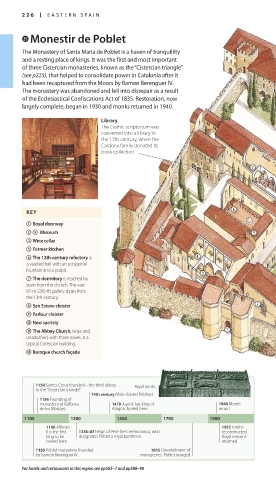
Library
The Gothic scriptorium was
converted into a library in
the 17th century, when the
Cardona family donated its
book collection.
KEY
1 Royal doorway
2 4 Museum
3 Wine cellar
5 Former kitchen
6 The 12th-century refectory is
a vaulted hall with an octagonal
fountain and a pulpit.
7 The dormitory is reached by
stairs from the church. The vast
87-m (285-ft) gallery dates from
the 13th century.
8 San Esteve cloister
9 Parlour cloister
0 New sacristy
q The Abbey Church, large and
unadorned, with three naves, is a
typical Cistercian building.
w Baroque church façade
1150 Santes Creus founded – the third abbey Royal tombs
in the “Cistercian triangle”
14th century Main cloister finished
1156 Founding of
monastery at Vallbona 1479 Juan II, last king of 1940 Monks
de les Monges Aragón, buried here return
1100 1300 1500 1700 1900
1196 Alfonso 1952 Tombs
II is the first 1336–87 Reign of Pere the Ceremonious, who reconstructed.
king to be designates Poblet a royal pantheon Royal remains
buried here returned
1150 Poblet monastery founded 1835 Disentailment of
by Ramón Berenguer IV monasteries. Poblet ravaged
For hotels and restaurants in this region see pp565–7 and pp588–90
226-227_EW_Spain.indd 226 05/10/15 2:46 pm
Eyewitness Travel LAYERS PRINTED:
Starsight template “UK” LAYER
(Source v2.5)
Date 6th February2013
Size 125mm x 217mm

