


Page 231 - (DK Eyewitness) Travel Guide - Spain
P. 231
C A T AL ONIA 229
Head of Medusa. Among the c Tortosa v Delta de L’Ebre
most impressive remains are Tarragona. * 33,700. n Rambla Tarragona. £ Aldea. @ Deltebre,
the huge Pre-Roman stones on Felip Pedrell 3, 977 44 96 48. ( Mon. Aldea. n Deltebre, 977 48 93 09.
which the Roman wall is built. _ Nostra Senyora de la Cinta (Aug/ ∑ turismedeltebre.com
An archaeological walk stretches Sep). ∑ tortosaturisme.cat
1 km (half a mile) along the wall. The delta of the Riu Ebre is a
Behind the wall lies the 12th- A ruined castle and medieval prosperous rice-growing region
century cathedral, built on the walls are clues to Tortosa’s and wildlife haven. Some
site of a Roman temple. This historical importance. Sited at 70 sq km (27 sq miles) have
evolved over many centuries, as the lowest crossing point on the been turned into a nature
seen from the blend Riu Ebre (Río Ebro), reserve, the Parc Natural del
of styles of the it has been strategi- Delta de L’Ebre. In Deltebre
exterior. Inside is an cally significant since there is an information centre
alabaster altarpiece Iberian times. The and an interesting Eco-Museu,
of St Tecla, carved by Moors held the city with an aquarium containing
Pere Joan in 1434. The from the 8th century species found in the delta.
13th-century cloister until 1148. The old The main towns in the area
has Gothic vaulting, Moorish castle, known are Amposta and Sant Carles de
but the doorway as La Zuda, is all that la Ràpita, both of which serve
is Romanesque. remains of their as good bases for exploring
To the west of defences. It has the reserve.
town is a 3rd- to been renovated The best sites for seeing
6th-century Chris- as a parador. The wildlife are along the shore,
tian cemetery, Moors also built from the Punta del Fangar in the
the Necròpolis Ruins of the Necropolis a mosque in 914. north to the Punta de la Banya
Paleocristiana i Paleocristiana, Tarragona Its foundations in the south. Every where is
Conjunt Paleocristià were used for accessible by car except Illa de
del Francolí. the cathedral, on which work Buda. Flamingoes breed on this
began in 1347. Although not island, and other waterbirds,
Environs completed for 200 years, the such as avocets, can be seen
The Aqüeducte de les Ferreres style is Gothic. from tourist boats that leave
lies just outside the city, next Tortosa was badly damaged from Riumar and Deltebre.
to the A7 motorway. This in 1938–9 during one of the
2nd-century aqueduct was built fiercest battles of the Civil War E Eco-Museu
to bring water to the city from (see pp68–71), when the Ebre Carrer Doctor Martí Buera 22. Tel 977
the Riu Gaià, 30 km (19 miles) formed the front line between 48 96 79. Open Tue–Sun. Closed 1 & 6
to the north. The Arc de Berà, the opposing forces. Jan, 25 & 26 Dec. & 7 8
a 1st-century triumphal arch on
the Via Augusta, is 20 km (12
miles) northeast on the N340. The Sardana
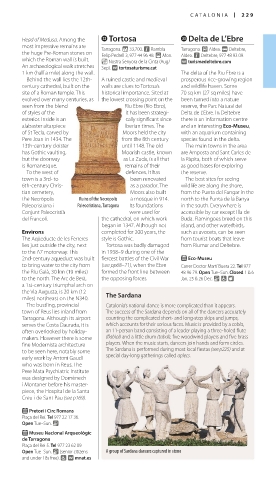
The bustling, provincial Catalonia’s national dance is more complicated than it appears.
town of Reus lies inland from The success of the Sardana depends on all of the dancers accurately
Tarragona. Although its airport counting the complicated short- and long-step skips and jumps,
serves the Costa Daurada, it is which accounts for their serious faces. Music is provided by a cobla,
often overlooked by holiday- an 11-person band consisting of a leader playing a three-holed flute
makers. However there is some (flabiol) and a little drum (tabal), five woodwind players and five brass
fine Modernista architecture players. When the music starts, dancers join hands and form circles.
to be seen here, notably some The Sardana is performed during most local fiestas (see p225) and at
early work by Antoni Gaudí special day-long gatherings called aplecs.
who was born in Reus. The
Pere Mata Psychiatric Institute
was designed by Domènech
i Montaner before his master-
piece, the Hospital de la Santa
Creu i de Sant Pau (see p169).
E Pretori i Circ Romans
Plaça del Rei. Tel 977 22 17 36.
Open Tue–Sun. &
E Museu Nacional Arqueològic
de Tarragona
Plaça del Rei 5. Tel 977 23 62 09.
Open Tue–Sun. & (senior citizens A group of Sardana dancers captured in stone
and under 18s free). 7 ∑ mnat.es
228-229_EW_Spain.indd 229 26/09/17 11:01 am

