


Page 236 - (DK Eyewitness) Travel Guide - Spain
P. 236
234 EASTERN SP AIN
2 Los Valles scattered beside the tourist
information office of Hecho,
Huesca. £ Jaca. @ from Jaca
to Hecho. n Museo de Arte from an open-air festival
Contemporáneo al aire libre, previously held in the village.
Pallar d’Agustin, Hecho (Jun–Sep), The bucolic village of Siresa,
974 37 55 05. which contains the 11th-
century church of San Pedro,
The delightful valleys of Ansó lies to the north of Hecho.
and Hecho, formed by the
Veral and Aragón Subordán 3 Puerto de
rivers respectively, were once
isolated due to poor road links, Somport
enabling their villages to retain
The town hall, Sos del Rey Católico traditional customs and a local Huesca. @ Somport, Astun or Jaca.
n Pl Ayuntamiento 1, Canfranc, 974
dialect called Cheso. Now the
1 Sos del Rey area’s crafts and costumes have 37 31 41 (closed Sep–Jun: Sun & Mon).
Católico made it popular with tourists. Just inside the border with
The Pyrenean foothills and France, the Somport Pass
Zaragoza. * 650. @ n Palacio forests above the valleys are was for centuries a strategic
de Sada, Plaza Hispanidad s/n, 948 88 good for walking, fishing and crossing point for the Romans
85 24 (closed Mon). ( Fri. _ Fiesta cross-country skiing. and Moors, and for medieval
Mayor (third week of Aug). 8 to Ansó lies in the prettiest pilgrims en route to Santiago de
Palacio de Sada. ∑ oficinaturismo valley, which becomes a Compostela (see pp86–7). Today
sosdelreycatolico.com
shadowy gorge where the the austere scenery is specked
Fernando of Aragón – the Río Veral and the road next to with holiday apart ments built
so-called “Catholic King” who it squeeze between vertical for skiing. Astún is modern
married Isabel of Castile, thereby crags and through rock tunnels. and well organized, while El
uniting Spain (see pp60–61) – was Many of its buildings have Formigal, to the east, is a stylish,
born in this small town in 1452, stone façades and steep, tiled purpose-built resort. Non-skiers
thus its distinguished royal name. roofs. The Gothic church can enjoy the scenery around
The Palacio de Sada, the (16th century) has a museum the Panticosa gorge. Sallent
king’s reputed birthplace, with dedicated to local costume. de Gállego is popular for rock
a beautiful inner courtyard, is Pieces of modern sculpture lie climbing and fishing.
among the town’s grandest
stone mansions. It stands in a
small square amid a maze of
narrow cobbled streets. At the
top of the town are the rem nants
of a castle and the Iglesia de San
Esteban. The church’s font and
carved capitals are note worthy,
as are the 13th-century frescoes
in two of the crypt’s apses. From
here there are fine views over
the surrounding hills.
The Gothic-arched Lonja
(commodities exchange) and
the 16th-century town hall
(ayuntamiento) are located
on the adjacent main square.
Environs
The “Cinco Villas” are five towns
recognized by Felipe V for their
loyalty during the War of the
Spanish Succes sion (see p66).
Sos del Rey Católico is the
most appealing of these. The
others are Ejea de los Caballeros,
Tauste, Sádaba and Uncastillo.
The latter, 20 km (12 miles) to
the southeast, has a fortress
and a Romanesque church,
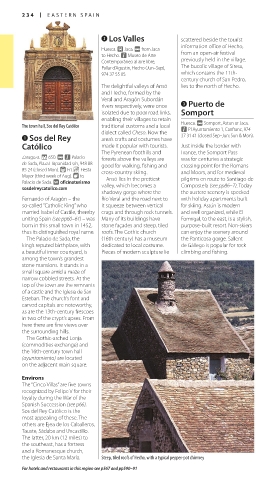
the Iglesia de Santa María. Steep, tiled roofs of Hecho, with a typical pepper-pot chimney
For hotels and restaurants in this region see p567 and pp590–91
234-235_EW_Spain.indd 234 26/09/17 11:01 am
Eyewitness Travel LAYERS PRINTED:
Catalogue template “UK” LAYER
(Source v2.1)
Date 5th December 2012
Size 125mm x 217mm

