


Page 279 - (DK Eyewitness) Travel Guide - Spain
P. 279
OLD M ADRID 277
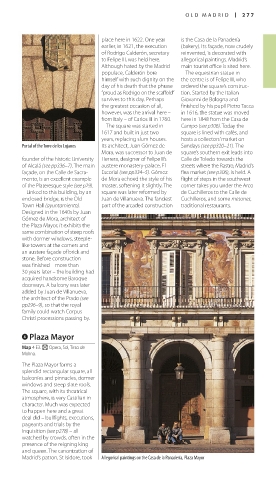
place here in 1622. One year is the Casa de la Panadería
earlier, in 1621, the execution (bakery). Its façade, now crudely
of Rodrigo Calderón, secretary reinvented, is decorated with
to Felipe III, was held here. allegorical paintings. Madrid’s
Although hated by the Madrid main tourist office is sited here.
populace, Calderón bore The equestrian statue in
himself with such dignity on the the centre is of Felipe III, who
day of his death that the phrase ordered the square’s construc
“proud as Rodrigo on the scaffold” tion. Started by the Italian
survives to this day. Perhaps Giovanni de Bologna and
the greatest occasion of all, finished by his pupil Pietro Tacca
however, was the arrival here – in 1616, the statue was moved
from Italy – of Carlos III in 1760. here in 1848 from the Casa de
The square was started in Campo (see p306). Today the
1617 and built in just two square is lined with cafés, and
years, replacing slum houses. hosts a collectors’ market on
Portal of the Torre de los Lujanes Its architect, Juan Gómez de Sundays (see pp320–21). The
Mora, was successor to Juan de square’s southern exit leads into
founder of the historic University Herrera, designer of Felipe II’s Calle de Toledo towards the
of Alcalá (see pp336–7). The main austere monasterypalace, El streets where the Rastro, Madrid’s
façade, on the Calle de Sacra Escorial (see pp334–5). Gómez flea market (see p306), is held. A
mento, is an excellent example de Mora echoed the style of his flight of steps in the south west
of the Plateresque style (see p29). master, softening it slightly. The corner takes you under the Arco
Linked to this building, by an square was later reformed by de Cuchilleros to the Calle de
enclosed bridge, is the Old Juan de Villanueva. The fanciest Cuchilleros, and some mesones,
Town Hall (ayuntamiento). part of the arcaded construction traditional restaurants.
Designed in the 1640s by Juan
Gómez de Mora, architect of
the Plaza Mayor, it exhibits the
same combination of steep roofs
with dormer windows, steeple
like towers at the corners and
an austere façade of brick and
stone. Before construction
was finished – more than
30 years later – the building had
acquired hand some Baroque
doorways. A balcony was later
added by Juan de Villanueva,
the architect of the Prado (see
pp296–9), so that the royal
family could watch Corpus
Christi processions passing by.
4 Plaza Mayor
Map 4 E3. Opera, Sol, Tirso de
Molina.
The Plaza Mayor forms a
splendid rectangular square, all
balconies and pinnacles, dormer
windows and steep slate roofs.
The square, with its theatrical
atmosphere, is very Castilian in
character. Much was expected
to happen here and a great
deal did – bullfights, executions,
pageants and trials by the
Inquisition (see p278) – all
watched by crowds, often in the
presence of the reigning king
and queen. The canonization of
Madrid’s patron, St Isidore, took Allegorical paintings on the Casa de la Panadería, Plaza Mayor
276-277_EW_Spain.indd 277 26/09/17 11:02 am

