


Page 336 - (DK Eyewitness) Travel Guide - Spain
P. 336
334 M ADRID
6 El Escorial
Felipe II’s imposing grey palace of San Lorenzo de El Escorial
stands out against the foothills of the Sierra de Guadarrama
to the northwest of Madrid. It was built between 1563 and
1584 in honour of St Lawrence, and its unornamented severity
set a new architectural style, known as Herreriano, which
became one of the most influential in Spain. The interior
was conceived as a mausoleum and contemplative retreat
rather than a splendid residence. Its artistic wealth, which
includes some of the most important works of art of the
royal Habsburg collections, is concentrated in the museums,
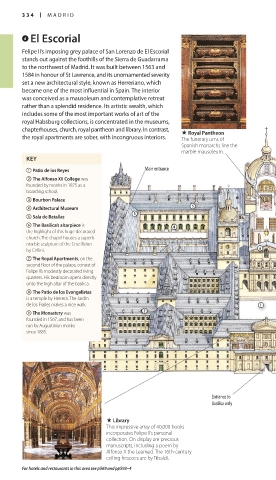
chapterhouses, church, royal pantheon and library. In contrast, . Royal Pantheon
the royal apartments are sober, with incongruous interiors. The funerary urns of
Spanish monarchs line the
marble mausoleum.
KEY
1 Patio de los Reyes Main entrance
2 The Alfonso XII College was
founded by monks in 1875 as a
boarding school.
3 Bourbon Palace
4 Architectural Museum
5 Sala de Batallas
6 The Basílica’s altarpiece is
the highlight of this huge decorated
church. The chapel houses a superb
marble sculpture of the Cruci fixion
by Cellini.
7 The Royal Apartments, on the
second floor of the palace, consist of
Felipe II’s modestly decorated living
quarters. His bedroom opens directly
onto the high altar of the basilica.
8 The Patio de los Evangelistas
is a temple by Herrera. The Jardín
de los Frailes makes a nice walk.
9 The Monastery was
founded in 1567, and has been
run by Augustinian monks
since 1885.
Entrance to
Basilica only
. Library
This impressive array of 40,000 books
incorporates Felipe II’s personal
collection. On display are precious
manuscripts, including a poem by
Alfonso X the Learned. The 16th-century
ceiling frescoes are by Tibaldi.
For hotels and restaurants in this area see p569 and pp593–4
334-335_EW_Spain.indd 334 26/09/17 11:02 am

