


Page 339 - (DK Eyewitness) Travel Guide - Spain
P. 339
M ADRID PROVINCE 337
Cardinal Cisneros, Alcalá’s
university became one of the
foremost places of learning in
16th-century Europe. The most
historic college, San Ildefonso,
survives. Former students include
Golden Age playwright Lope de
Vega (see p294). In 1517 the uni-
versity produced Europe’s first
poly glot bible, with text in Latin,
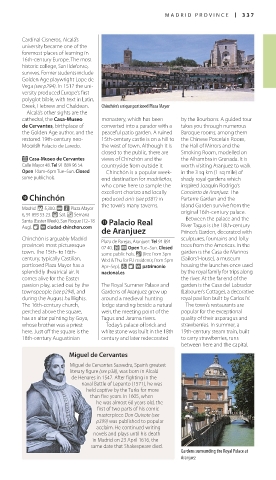
Greek, Hebrew and Chaldean. Chinchón’s unique porticoed Plaza Mayor
Alcalá’s other sights are the
cathedral, the Casa-Museo monastery, which has been by the Bour bons. A guided tour
de Cervantes, birthplace of converted into a parador with a takes you through numerous
the Golden Age author, and the peaceful patio garden. A ruined Baroque rooms, among them
restored 19th-century neo- 15th-century castle is on a hill to the Chi nese Porcelain Room,
Moorish Palacio de Laredo. the west of town. Although it is the Hall of Mirrors and the
closed to the public, there are Smoking Room, modelled on
E Casa-Museo de Cervantes views of Chinchón and the the Alh ambra in Granada. It is
Calle Mayor 48. Tel 91 889 96 54. countryside from outside it. worth visiting Aranjuez to walk
Open 10am–6pm Tue–Sun. Closed Chinchón is a popular week- in the 3 sq km (1 sq mile) of
some public hols. end destination for madrileños, shady royal gardens which
who come here to sample the inspired Joaquín Rodrigo’s
excellent chorizo and locally Concierto de Aranjuez. The
0 Chinchón produced anís (see p581) in Parterre Garden and the
the town’s many taverns. Island Garden survive from the
Madrid. * 5,300. @ n Plaza Mayor
6, 91 893 53 23. ( Sat. _ Semana original 16th-century palace.
Santa (Easter Week), San Roque (12–18 q Palacio Real Between the palace and the
Aug). 8 ∑ ciudad-chinchon.com River Tagus is the 18th-century
de Aranjuez Prince’s Garden, decorated with
Chinchón is arguably Madrid Plaza de Parejas, Aranjuez. Tel 91 891 sculptures, fountains and lofty
province’s most picturesque 07 40. £ @ Open Tue–Sun. Closed trees from the Americas. In the
town. The 15th- to 16th- some public hols. & (free from 3pm garden is the Casa de Marinos
century, typically Castilian, Wed & Thu for EU residents; from 5pm (Sailors’ House), a museum
porticoed Plaza Mayor has a Apr–Sep). 7 8 ∑ patrimonio housing the launches once used
splendidly theatrical air. It nacional.es by the royal family for trips along
comes alive for the Easter the river. At the far end of the
passion play, acted out by the The Royal Summer Palace and garden is the Casa del Labrador
townspeople (see p294), and Gardens of Aranjuez grew up (Labourer’s Cottage), a decorative
during the August bullfights. around a medieval hunting royal pavilion built by Carlos IV.
The 16th-century church, lodge standing beside a natu ral The town’s restaurants are
perched above the square, weir, the meeting point of the popular for the exceptional
has an altar painting by Goya, Tagus and Jarama rivers. quality of their asparagus and
whose brother was a priest Today’s palace of brick and strawberries. In summer, a
here. Just off the square is the white stone was built in the 18th 19th-century steam train, built
18th-century Augustinian century and later redecorated to carry strawberries, runs
between here and the capital.
Miguel de Cervantes
Miguel de Cervantes Saavedra, Spain’s greatest
literary figure (see p38), was born in Alcalá
de Henares in 1547. After fight ing in the
naval Battle of Lepanto (1571), he was
held captive by the Turks for more
than five years. In 1605, when
he was almost 60 years old, the
first of two parts of his comic
masterpiece Don Quixote (see
p399) was published to popular
acclaim. He continued writing
novels and plays until his death
in Madrid on 23 April 1616, the
same date that Shakespeare died.
Gardens surrounding the Royal Palace at
Aranjuez
336-337_EW_Spain.indd 337 26/09/17 11:02 am

