


Page 397 - (DK Eyewitness) Travel Guide - Spain
P. 397
T OLEDO 395
P Sinagoga de Santa María E Museo del Greco
la Blanca Paseo del Tránsito. Tel 925 22 36 65.
Calle de los Reyes Católicos 4. Open Tue–Sun. Closed Mon, Sun pm.
Tel 925 22 72 57. Open daily. & (free Sat pm, Sun). 7
Closed 1 Jan, 25 Dec. & 7 ∑ museodelgreco.mcu.es
The oldest and largest of the This museum is located in the
city’s original synagogues, this heart of the Jewish quarter, in a
monument dates back to the house near to the one in which
12th–13th century. In 1405 it El Greco lived. It has a wide
was taken over as a church by collection of his works. Canvases
San Vincente Ferrer after the on display include View of Toledo,
expulsion of the Jews. Resto- a detailed depiction of the city
ration has returned it to its at the time, and the superb
original beauty – carved stone series Christ and the Apostles.
capitals and wall panels stand Underneath the museum, on
out against white horseshoe the ground floor, is a domestic
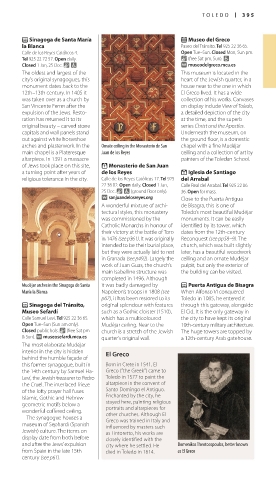
arches and plasterwork. In the Ornate ceiling in the Monasterio de San chapel with a fine Mudéjar
main chapel is a Plateresque Juan de los Reyes ceiling and a collection of art by
altar piece. In 1391 a massacre painters of the Toledan School.
of Jews took place on this site, R Monasterio de San Juan
a turning point after years of de los Reyes R Iglesia de Santiago
religious tolerance in the city. Calle de los Reyes Católicos 17. Tel 925 del Arrabal
22 38 02. Open daily. Closed 1 Jan, Calle Real del Arrabal. Tel 925 22 06
25 Dec. & 7 (ground floor only). 36. Open for mass.
∑ sanjuandelosreyes.org Close to the Puerta Antigua
A wonderful mixture of archi- de Bisagra, this is one of
tectural styles, this monastery Toledo’s most beautiful Mudéjar
was commissioned by the monuments. It can be easily
Catholic Monarchs in honour of identified by its tower, which
their victory at the battle of Toro dates from the 12th-century
in 1476 (see p361). It was originally Reconquest (see pp58–9). The
intended to be their burial place, church, which was built slightly
but they were actually laid to rest later, has a beautiful woodwork
in Granada (see p492). Largely the ceiling and an ornate Mudéjar
work of Juan Guas, the church’s pulpit, but only the exterior of
main Isabelline structure was the building can be visited.
com pleted in 1496. Although
Mudéjar arches in the Sinagoga de Santa it was badly damaged by P Puerta Antigua de Bisagra
María la Blanca Napoleon’s troops in 1808 (see When Alfonso VI conquered
p67), it has been restored to its Toledo in 1085, he entered it
P Sinagoga del Tránsito, original splendour with features through this gateway, along side
Museo Sefardí such as a Gothic cloister (1510), El Cid. It is the only gateway in
Calle Samuel Leví. Tel 925 22 36 65. which has a multicoloured the city to have kept its original
Open Tue–Sun (Sun am only). Mudéjar ceiling. Near to the 10th-century military architecture.
Closed public hols. & (free Sat pm church is a stretch of the Jew ish The huge towers are topped by
& Sun). ∑ museosefardi.mcu.es quarter’s original wall. a 12th-century Arab gatehouse.
The most elaborate Mudéjar
interior in the city is hidden El Greco
behind the humble façade of
this former syna gogue, built in Born in Crete in 1541, El
the 14th century by Samuel Ha- Greco (“the Greek”) came to
Leví, the Jewish treasurer to Pedro Toledo in 1577 to paint the
the Cruel. The interlaced frieze altarpiece in the convent of
of the lofty prayer hall fuses Santo Domingo el Antiguo.
Islamic, Gothic and He brew Enchanted by the city, he
geometric motifs below a stayed here, painting religious
portraits and altarpieces for
wonderful coffered ceiling. other churches. Although El
The synagogue houses a Greco was trained in Italy and
museum of Sephardi (Spanish influenced by masters such
Jewish) culture. The items on as Tintoretto, his works are
display date from both before closely identified with the
and after the Jews’ expulsion city where he settled. He Domenikos Theotocopoulos, better known
from Spain in the late 15th died in Toledo in 1614. as El Greco
century (see p61).
394-395_EW_Spain.indd 395 26/09/17 11:54 am

