


Page 412 - (DK Eyewitness) Travel Guide - Spain
P. 412
410 CENTR AL SP AIN
7 Parque Nacional
de Monfragüe
Cáceres. @ Villarreal de San Carlos.
n Villarreal de San Carlos, 927 19
91 34. Open daily. ∑ turismo
extremadura.com
To the south of Plasencia, rolling
hills drop from scrubby peaks
through wild olive and cork
woods to the dammed Tagus
and Tiétar river valleys;
Monfragüe has outstandingly
varied wildlife, including a large
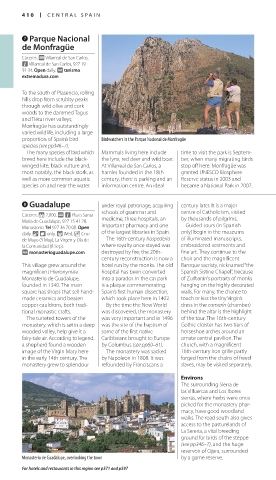
proportion of Spain’s bird Birdwatchers in the Parque Nacional de Monfragüe
species (see pp346–7).
The many species of bird which Mammals living here include time to visit the park is Sep tem-
breed here include the black- the lynx, red deer and wild boar. ber, when many mi grating birds
winged kite, black vul ture and, At Villarreal de San Carlos, a stop off here. Monfragüe was
most notably, the black stork, as hamlet founded in the 18th granted UNESCO Biosphere
well as more common aquatic century, there is parking and an Reserve status in 2003 and
species on and near the water. information centre. An ideal became a National Park in 2007.
8 Guadalupe under royal pat ronage, acquiring century later. It is a major
schools of grammar and centre of Catholicism, visited
Cáceres. * 2,000. @ n Plaza Santa
María de Guadalupe, 927 15 41 28. medicine, three hospitals, an by thousands of pilgrims.
Monasterio: Tel 927 36 70 00. Open important phar macy and one Guided tours (in Spanish
daily. & 8 only. ( Wed. _ Cruz of the largest libraries in Spain. only) begin in the museums
de Mayo (3 May), La Virgen y Día de The 16th-century hospedería of illuminated manuscripts,
la Comunidad (8 Sep). where royalty once stayed was embroidered vestments and
∑ monasterioguadalupe.com destroyed by fire; the 20th- fine art. They continue to the
century reconstruction is now a choir and the magnificent
This village grew around the hotel run by the monks. The old Baroque sacristy, nicknamed “the
magnificent Hieronymite hospital has been converted Spanish Sistine Chapel”, because
Monasterio de Guadalupe, into a parador. In the car park of Zurbarán’s portraits of monks
founded in 1340. The main is a plaque commemorating hanging on the highly decorated
square has shops that sell hand- Spain’s first human dissection, walls. For many, the chance to
made ceramics and beaten which took place here in 1402. touch or kiss the tiny Virgin’s
copper cauldrons, both tradi- By the time the New World dress in the camarín (chamber)
tional monastic crafts. was discovered, the monastery behind the altar is the highlight
The turreted towers of the was very important and in 1496 of the tour. The 16th-century
monastery, which is set in a deep was the site of the bap tism of Gothic cloister has two tiers of
wooded valley, help give it a some of the first native horse shoe arches around an
fairy-tale air. According to legend, Caribbeans brought to Europe ornate central pavilion. The
a shepherd found a wooden by Columbus (see pp60–61). church, with a magnificent
image of the Virgin Mary here The monastery was sacked 16th-century iron grille partly
in the early 14th century. The by Napoleon in 1808. It was forged from the chains of freed
monastery grew to splendour refounded by Franciscans a slaves, may be visited separately.
Environs
The surrounding Sierra de
las Villuercas and Los Ibores
sierras, where herbs were once
picked for the monastery phar-
macy, have good woodland
walks. The road south also gives
access to the pasturelands of
La Serena, a vital breeding
ground for birds of the steppe
(see pp346–7), and the huge
reservoir of Cíjara, surrounded
Monasterio de Guadalupe, overlooking the town by a game reserve.
For hotels and restaurants in this region see p571 and p597
410-411_EW_Spain.indd 410 26/09/17 11:54 am

