


Page 414 - (DK Eyewitness) Travel Guide - Spain
P. 414
412 CENTR AL SP AIN
0 Street-by-Street: Cáceres
After Alfonso IX of Leon conquered Cáceres in 1229,
its growing prosperity as a free trade town attracted
merchants, and later aristocracy, to settle here. They
rivalled each other with stately homes and palaces
fortified by watchtowers, most of which Isabel and
Fernando, the reigning monarchs (see pp60–61), ordered
to be demolished in 1476 to halt the continual jostling
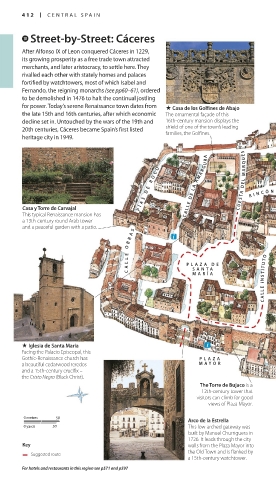
for power. Today’s serene Renaissance town dates from . Casa de los Golfines de Abajo
the late 15th and 16th centuries, after which economic The ornamental façade of this
decline set in. Untouched by the wars of the 19th and 16th-century mansion displays the
20th centuries, Cáceres became Spain’s first listed shield of one of the town’s leading
families, the Golfines.
heritage city in 1949.
O
C
O
R C U E S TA D E L M A R Q U É S
E C A L L E D E L A A M A R G U R A
D R I N C Ó N D E L A M O N J A
S
A
Casa y Torre de Carvajal P Í
This typical Renaissance mansion has
a 13th-century round Arab tower
and a peaceful garden with a patio.
S
A
R
O B
E
C A L L E I N S T I T U T O C U E S T A DE ALDANA
L
L PL A Z A DE
A SANT A
C M ARÍA
. Iglesia de Santa María
Facing the Palacio Episcopal, this
Gothic-Renaissance church has P LAZ A
a beautiful cedarwood reredos M AY O R
and a 15th-century crucifix –
the Cristo Negro (Black Christ).
The Torre de Bujaco is a
12th-century tower that
visitors can climb for good
views of Plaza Mayor.
0 metres 50
Arco de la Estrella
0 yards 50 This low-arched gate way was
built by Manuel Churriguera in
1726. It leads through the city
Key walls from the Plaza Mayor into
the Old Town and is flanked by
Suggested route
a 15th-century watchtower.
For hotels and restaurants in this region see p571 and p597
412-413_EW_Spain.indd 412 26/09/17 11:03 am
Eyewitness Travel LAYERS PRINTED:
Starsight template “UK” LAYER
(Source v2.5)
Date 6th February2013
Size 125mm x 217mm

