


Page 418 - (DK Eyewitness) Travel Guide - Spain
P. 418
416 CENTR AL SP AIN
t Badajoz revealed a moated temple that
was rebuilt three times – many
Badajoz. * 152,500. ~ £ @
n Pasaje de San Juan, 924 22 49 81. of the walls and slate floors are
( Tue & Sun. _ Carnival (Feb/Mar). still intact. Each temple was
∑ turismobadajoz.es constructed on a grander scale
than the pre vious one and then
Badajoz was a major centre burned in the face of invasion
under the Moors, but centuries during the 6th century BC.
of conflict robbed it of its former Most of the artifacts
glories. Today, it is mostly known unearthed from the site are on
for its extravagant Carnival. display in the archaeo logical
The Alcazaba houses the museum at Badajoz.
Museo Arqueológico, which has
over 15,000 pieces from around Environs
the province, as far back as A Roman funereal monument
Palaeolithic times. The fortress stands next to the church in
overlooks colourful Plaza Alta, a Interior of Santa María Magdalena nearby Zalamea de la Serena.
former medieval market square. church, Olivenza The town comes alive during
Dating from the 13th–18th the August fiestas, when the
centuries, the cathedral has a The 16th-century Santa Casa de townsfolk act out the classic
stunning tiled cloister. The MEIAC Misericordia has blue and white 17th-century play, The Mayor of
museum of contempo rary tiled friezes. In one, God offers Zalamea, by Calderón de la Barca
Spanish and Latin American art is Adam and Eve 18th-century (see p38), which was supposedly
on Calle Museo (open Tue–Sun). coats to cover their nakedness. based on a local character. Shops
Off the main square, the in the town also sell torta de la
E Museo Arqueológico Casa Fuentes bakery sells Técula Serena, a strong, creamy cheese
Plaza José Álvarez Saez de Buruaga. Mécula cake. made of sheep’s milk.
Tel 924 00 19 08. Open Tue–Sun.
E Museo Etnográfico
González Santana
y Olivenza Plaza de Santa María. Tel 924 49 02 22.
Open Tue–Sun. & 7
Badajoz. * 12,000. @ n Pl de Santa ∑ elmuseodeolivenza.com
María del Castillo 15, 924 49 01 51. (
Sat. _ Muñecas de San Juan (23 Jun).
A Portuguese enclave until u Cancho Roano
1801, Olivenza has a lively vibe. Zalamea de la Serena, EX114 (Carre-
Within the walled town are the tera Zalamea-Quintana) km 3. Tel 629
medieval castle, housing the 23 52 79. Open daily (except Sun pm).
Museo Etnográfico González Closed some public hols.
Santana, a museum of rural
life, and three churches. Santa This sanctuary-palace, which
María del Castillo has a family is thought to have been built
tree of the Virgin Mary. Santa under the civilization of Tart- Remains of the Tartessan sanctuary at
María Magdalena is a fine essus (see p53), was discov ered Cancho Roano
example of the 16th-century in the 1960s. Excavations on this
Portuguese Manueline style. small site (begun in 1978) have
i Zafra
Badajoz. * 16,700. £ @ n Plaza
de España 8, 924 55 10 36. ( Sun &
last Sat of month. _ San Miguel
(Sep/Oct). ∑ visitazafra.com
At the heart of this graceful
town, nicknamed “little Seville”
because of its similarity to the
capital of Andalucía, are two
arcaded squares. The Plaza
Grande, the larger of the two,
near the Iglesia de la Candelaria,
was built in the 15th century.
The older square is Plaza Chica,
which used to be the market-
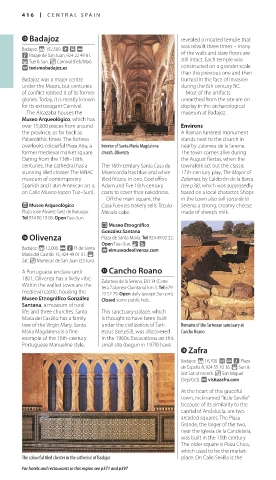
The colourful tiled cloister in the cathedral of Badajoz place. On Calle Sevilla is the
For hotels and restaurants in this region see p571 and p597
416-417_EW_Spain.indd 416 26/09/17 11:03 am

