


Page 472 - (DK Eyewitness) Travel Guide - Spain
P. 472
470 SOUTHERN SP AIN
6 Parque Nacional de Doñana
Doñana National Park is ranked among Europe’s greatest
wetlands. Together with its adjoining protected areas,
the park covers in excess of 500 sq km (193 sq miles)
of marshes and sand dunes. The area used to be a
hunting ground (coto) belonging to the Dukes of
Medina Sidonia. As the land was never suitable for
human settlers, wildlife was able to flourish. In 1969,
this large area became officially protected. In addition
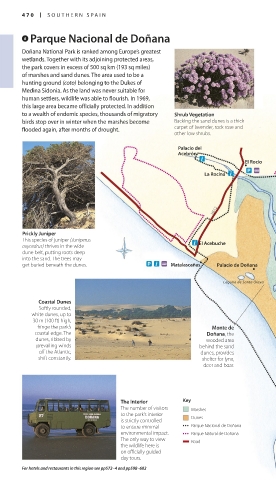
to a wealth of endemic species, thousands of migratory Shrub Vegetation
birds stop over in winter when the marshes become Backing the sand dunes is a thick
flooded again, after months of drought. carpet of lavender, rock rose and
other low shrubs.
Palacio del
Acebrón
El Rocío
La Rocina
H612
Prickly Juniper
This species of juniper (Juniperus El Acebuche
oxycedrus) thrives in the wide
dune belt, putting roots deep
into the sand. The trees may
get buried beneath the dunes. Matalascañas Palacio de Doñana
Laguna de Santa Olaya
Coastal Dunes
Softly rounded,
white dunes, up to
30 m (100 ft) high,
fringe the park’s Monte de
coastal edge. The Doñana, the
dunes, ribbed by wooded area
prevailing winds behind the sand
off the Atlantic, dunes, provides
shift constantly. shelter for lynx,
deer and boar.
The Interior Key
The number of visitors Marshes
to the park’s interior Dunes
is strictly controlled
to ensure minimal Parque Nacional de Doñana
environmental impact. Parque Natural de Doñana
The only way to view Road
the wildlife here is
on officially guided
day tours.
For hotels and restaurants in this region see pp572–4 and pp598–602
470-471_EW_Spain.indd 470 26/09/17 11:55 am

