


Page 473 - (DK Eyewitness) Travel Guide - Spain
P. 473
AND AL UCÍA 471
VISITORS’ CHECKLIST
Practical Information
Deer Huelva & Sevilla.
Fallow deer (Dama dama) ∑ reddeparquesnacionales.
and larger red deer (Cervus mma.es
elaphus) roam the park. Marginal areas: Open daily.
Stags engage in fierce Closed 1 & 6 Jan, Pente cost, 25
contests in late summer as Dec. n La Rocina: Tel 959 43
they prepare for breeding. 95 69. n Palacio del Acebrón:
exhibition “Man and Doñana”.
n El Acebuche: reception,
Wild cattle use exhibition, café & shop. Tel 959
the marshes as 50 61 22. Self-guided paths:
waterholes. La Rocina & Charco de la Boca
(3.5 km); El Acebrón from Palacio
del Acebrón (1.5 km); Laguna
del Acebuche from Acebuche
(1.5 km). Inner park areas: Open
May–mid-Sep: Mon–Sat; mid-
Río Guadiamar Sep–Apr: Tue–Sun. Guided tour
only. Jeeps leave El Acebuche at
8:30am & 3pm (5pm in summer).
Book ings: Tel 959 43 04 32. &
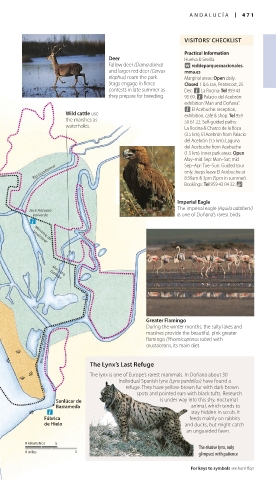
Imperial Eagle
The imperial eagle (Aquila adalberti)
José Antonio
Valverde is one of Doñana’s rarest birds.
Marisma de
Iznalcázar
Marisma
Gallega
Greater Flamingo
During the winter months, the salty lakes and
marshes provide the beautiful, pink greater
Río Guadalquivir crustaceans, its main diet.
flamingo (Phoenicopterus ruber) with
The Lynx’s Last Refuge
The lynx is one of Europe’s rarest mammals. In Doñana about 30
individual Spanish lynx (Lynx pardellus) have found a
refuge. They have yellow-brown fur with dark brown
spots and pointed ears with black tufts. Research
Sanlúcar de is under way into this shy, nocturnal
Barrameda animal, which tends to
stay hidden in scrub. It
Fábrica feeds mainly on rabbits
de Hielo and ducks, but might catch
an unguarded fawn.
0 kilometres 5
The elusive lynx, only
0 miles 5 glimpsed with patience
For keys to symbols see back flap
470-471_EW_Spain.indd 471 26/09/17 11:55 am

