


Page 507 - (DK Eyewitness) Travel Guide - Spain
P. 507
AND AL UCÍA 505
W Parque Natural
de Cabo de Gata
Almería. @ San José. n Centro de
Visitantes de las Amoladeras, Carretera
Alp-202 km 7 (Retamar-Pujaire), 950
16 04 35. Open daily.
Towering cliffs of volcanic
rock, sand dunes, salt flats and
secluded coves charac terize the
290-sq-km (110-sq-mile) Parque
Natural de Cabo de Gata. Within
its confines are a few fishing
villages, and the small resort
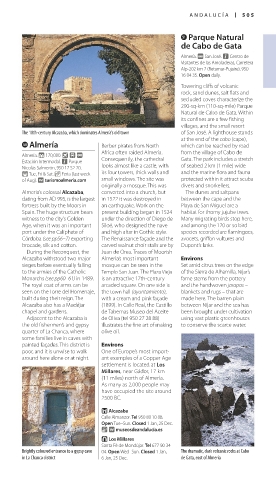
The 10th-century Alcazaba, which dominates Almería’s old town of San José. A lighthouse stands
at the end of the cabo (cape),
Q Almería Berber pirates from North which can be reached by road
Africa often raided Almería. from the village of Cabo de
Almería. * 170,000. k £ @
Estación Intermodal. n Parque Consequently, the cathedral Gata. The park includes a stretch
Nicolás Salmerón, 950 17 52 20. looks almost like a castle, with of sea bed 2 km (1 mile) wide
( Tue, Fri & Sat. _ Feria (last week its four towers, thick walls and and the marine flora and fauna
of Aug). ∑ turismoalmeria.com small windows. The site was protected within it attract scuba
originally a mosque. This was divers and snorkellers.
Almeria’s colossal Alcazaba, converted into a church, but The dunes and saltpans
dating from AD 995, is the largest in 1522 it was destroyed in be tween the cape and the
fortress built by the Moors in an earthquake. Work on the Playa de San Miguel are a
Spain. The huge structure bears pres ent building began in 1524 habitat for thorny jujube trees.
witness to the city’s Golden under the direction of Diego de Many migrating birds stop here,
Age, when it was an important Siloé, who designed the nave and among the 170 or so bird
port under the Caliphate of and high altar in Gothic style. species recorded are flamingoes,
Córdoba (see pp56–7) exporting The Renaissance façade and the avocets, griffon vultures and
brocade, silk and cotton. carved walnut choir stalls are by Dupont’s larks.
During the Reconquest, the Juan de Orea. Traces of Moorish
Alcazaba withstood two major Almería’s most important Environs
sieges before eventually falling mosque can be seen in the Set amid citrus trees on the edge
to the armies of the Catholic Templo San Juan. The Plaza Vieja of the Sierra de Alhamilla, Níjar’s
Monarchs (see pp60–61) in 1489. is an attractive 17th-century fame stems from the pottery
The royal coat of arms can be arcaded square. On one side is and the hand woven jarapas –
seen on the Torre del Homenaje, the town hall (ayuntamiento), blankets and rugs – that are
built during their reign. The with a cream and pink façade made here. The barren plain
Alcazaba also has a Mudéjar (1899). In Calle Real, the Castillo between Níjar and the sea has
chapel and gardens. de Tabernas Museo del Aceite been brought under cultivation
Adjacent to the Alcazaba is de Oliva (tel 950 27 28 88) using vast plastic greenhouses
the old fishermen’s and gypsy illustrates the fine art of making to conserve the scarce water.
quarter of La Chanca, where olive oil.
some families live in caves with
painted façades. This district is Environs
poor, and it is unwise to walk One of Europe’s most import-
around here alone or at night. ant examples of a Copper Age
settlement is located at Los
Millares, near Gádor, 17 km
(11 miles) north of Almería.
As many as 2,000 people may
have occu pied the site around
2500 BC.
+ Alcazaba
Calle Almanzor. Tel 950 80 10 08.
Open Tue–Sun. Closed 1 Jan, 25 Dec.
& ∑ museosdeandalucia.es
T Los Millares
Santa Fé de Mondújar. Tel 677 90 34
Brightly coloured entrance to a gypsy cave 04. Open Wed–Sun. Closed 1 Jan, The dramatic, dark volcanic rocks at Cabo
in La Chanca district 6 Jan, 25 Dec. de Gata, east of Almería
504-505_EW_Spain.indd 505 26/09/17 11:03 am

