


Page 503 - (DK Eyewitness) Travel Guide - Spain
P. 503
AND AL UCÍA 501
Úbeda’s most historic square.
The Old Town is contained
within city walls that were first
raised by the Moors in 852.
Created on the orders of the
Bishop of Jaén around 1562,
the colossal former Hospital
de Santiago was designed
by Andrés de Vandelvira, who
refined the Spanish Renaissance
style into its more austere
characteristics. The façade is
flanked by square towers, one
topped with a blue-and-white-
tiled spire. The Museo Arqueo
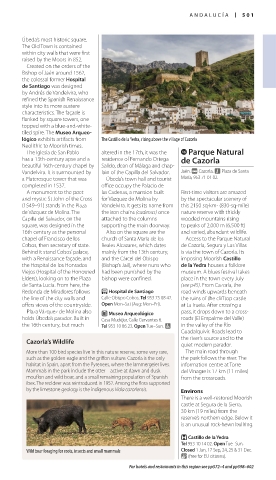
lógico exhibits artifacts from The Castillo de la Yedra, rising above the village of Cazorla
Neolithic to Moorish times.
The Iglesia de San Pablo altered in the 17th, it was the & Parque Natural
has a 13th-century apse and a residence of Fernando Ortega de Cazorla
beautiful 16th-century chapel by Salido, dean of Málaga and chap-
Vandelvira. It is surmounted by lain of the Capilla del Salvador. Jaén. @ Cazorla. n Plaza de Santa
a Plateresque tower that was Úbeda’s town hall and tourist María, 953 71 01 02.
completed in 1537. office occupy the Palacio de
A monument to the poet las Cadenas, a mansion built First-time visitors are amazed
and mystic St John of the Cross for Vázquez de Molina by by the spectacular scenery of
(1549–91) stands in the Plaza Vandelvira. It gets its name from this 2150 sq-km- (830-sq-mile)
de Vázquez de Molina. The the iron chains (cadenas) once nature reserve with thickly
Capilla del Salvador, on the attached to the columns wooded mountains rising
square, was designed in the supporting the main doorway. to peaks of 2,000 m (6,500 ft)
16th century as the personal Also on the square are the and varied, abundant wildlife.
chapel of Francisco de los church of Santa María de los Access to the Parque Natural
Cobos, then secretary of state. Reales Alcazares, which dates de Cazorla, Segura y Las Villas
Behind it stand Cobos’ palace, mainly from the 13th century, is via the town of Cazorla. Its
with a Renais sance façade, and and the Cárcel del Obispo impos ing Moorish Castillo
the Hospital de los Honrados (Bishop’s Jail), where nuns who de la Yedra houses a folklore
Viejos (Hos pital of the Honoured had been punished by the museum. A blues festival takes
Elders), looking on to the Plaza bishop were confined. place in the town every July
de Santa Lucía. From here, the (see p45). From Cazorla, the
Redonda de Miradores follows P Hospital de Santiago road winds upwards beneath
the line of the city walls and Calle Obispo Cobos. Tel 953 75 08 42. the ruins of the clifftop castle
offers views of the countryside. Open Mon–Sat (Aug: Mon–Fri). at La Iruela. After crossing a
Plaza Vázquez de Molina also E Museo Arqueológico pass, it drops down to a cross-
holds Úbeda’s parador. Built in Casa Mudéjar, Calle Cervantes 6. roads (El Empalme del Valle)
the 16th century, but much Tel 953 10 86 23. Open Tue–Sun. 7 in the valley of the Río
Guadalquivir. Roads lead to
the river’s source and to the
Cazorla’s Wildlife quiet modern parador.
More than 100 bird species live in this nature reserve, some very rare, The main road through
such as the golden eagle and the griffon vulture. Cazorla is the only the park follows the river. The
habitat in Spain, apart from the Pyrenees, where the lammergeier lives. information centre at Torre
Mammals in the park include the otter – active at dawn and dusk – del Vinagre is 17 km (11 miles)
mouflon and wild boar, and a small remaining population of Spanish from the crossroads.
ibex. The red deer was reintroduced in 1952. Among the flora supported
by the limestone geology is the indigenous Viola cazorlensis. Environs
There is a well-restored Moorish
castle at Segura de la Sierra,
30 km (19 miles) from the
reserve’s northern edge. Below it
is an unusual rock-hewn bullring.
+ Castillo de la Yedra
Tel 953 10 14 02. Open Tue–Sun.
Wild boar foraging for roots, insects and small mammals Closed 1 Jan, 17 Sep, 24, 25 & 31 Dec.
& (free for EU citizens).
For hotels and restaurants in this region see pp572–4 and pp598–602
500-501_EW_Spain.indd 501 26/09/17 11:56 am

