


Page 523 - (DK Eyewitness) Travel Guide - Spain
P. 523
THE BALEARIC ISLANDS 521
dates back to around 1000 BC, o Coves del Drac
originally consisted of five 500 m (0.3 miles) south of Porto Cristo.
talaiots (stone tower-like @ from Porto Cristo. Tel 971 82 07 53.
structures with timbered Open daily. Closed 1 Jan, 25 Dec. &
roofs) and another 28 smaller ∑ cuevasdeldrach.com
dwellings. Little is known about
its inhabitants and the uses for Mallorca has numerous caves,
some of the rooms inside the ranging from mere holes in
buildings, such as the tiny the ground to cathedral-like
underground gallery. Too small halls. The four vast chambers of
for living in, this room may the Coves del Drac are reached
have been used to perform by a steep flight of steps. At
magic rituals. the bottom is the beauti fully
Part of the charm of this lit cave, “Diana’s Bath”. An other
place lies in its surroundings chamber holds the under ground
among fields of fruit trees and lake, Martel, 29 m (95 ft) below
dry-stone walls, a setting that A street in Felanitx ground level and 177 m (580 ft)
somehow complements the long. Music fills the air of the cave,
ruins. Apart from a snack i Felanitx played from boats plying the
bar nearby, the site remains Baleares. * 17,300. @ n Avenida lake. Equally dramatic are the
mercifully undeveloped and Cala Marçal, Portocolom, 971 82 60 84. two remaining caves, charmingly
relatively peaceful. ( Sun. _ Sant Joan Pelós (24 Jun). named “The Theatre of the Fairies”
and “The Enchanted City”.
This bustling agricultural town
is the birthplace of Renaissance Environs
architect Guillem Sagrera The Coves d’Hams is so called
(1380– 1456) and the 20th- because some of its stalactites
century painter Miquel Barceló. are shaped like hooks – hams in
Felanitx is visited mainly for Mallorcan. The caves are 500 m
three reasons: the imposing (1,640 ft) long and contain the
façade of the 13th-century “Sea of Venice”, an under ground
church, the Esglesia de Sant lake on which musicians sail.
Miquel; its sobrassada de porc The entrance to the Coves
negre (a spiced raw sausage d’Artà, near Capdepera, is
made from the meat of the 40 m (130 ft) above sea level
local black pig), and its lively and affords a wonderful view.
religious fiestas including The caves’ main attraction is a
Sant Joan Pelós (see p527). stalagmite 22 m (72 ft) high.
One of the talaiots of Capocorb Vell About 5 km (3 miles) south-
east is the Castell de Santueri, } Coves d’Hams
founded by the Moors but Carretera Manacor–Porto Cristo,
u Cabrera re built in the 14th century by km 11.5. Tel 971 82 09 88. Open daily.
the kings of Aragón, who ruled Closed 1 Jan, 25 Dec. &
Baleares. g from Colònia Sant Jordi. ∑ cuevas delshams.com
n Carrer Gabriel Roca s/n, Colònia Mallorca. Though a ruin, it is
Sant Jordi, 971 65 60 73. worth the detour for the views } Coves d’Artà
to the east and south from its Carretera Coves s/n, Canyamel. Tel 971
From the beaches of Es Trenc vantage point, 400 m (1,300 ft) 84 12 93. Open daily. Closed 1 Jan, 25
and Sa Ràpita, on the south coast above the plain. Dec. & ∑ cuevasdearta.com
of Mallorca, Cabrera looms on
the horizon. The largest island
in an archipelago of the same
name, it lies 18 km (11 miles)
from the most southerly point
of Mallorca. Cabrera is home to
several rare plants, reptiles and
seabirds, such as Eleonora’s
falcon. The waters are important
for marine life. All this has resulted
in it being declared a national
park (see pp34–5). For centuries
Cabrera was used as a milit ary
base and it has a small popu-
lation. On it stand a 14th-
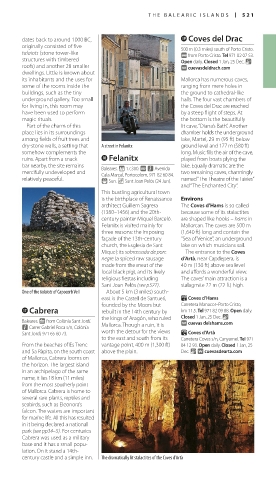
century castle and a simple inn. The dramatically lit stalactites of the Coves d’Artà
520-521_EW_Spain.indd 521 26/09/17 11:03 am

