


Page 528 - (DK Eyewitness) Travel Guide - Spain
P. 528
526 SP AIN ’ S ISLANDS
Menorca
Menorca is set apart from the rest of the country in many
ways, not least of which its distance from the mainland.
The coastline of Menorca is, argu ably, more unspoiled than
in any other part of Spain. Its countryside remains largely
green and pleasant with cows roaming the meadows. The
old towns of Maó – the island’s capital – and Ciutadella are
filled with noble, historic buildings and beautiful squares.
Menorca also has abundant reminders of its more distant
history: the island boasts a spectacular hoard of Bronze Age
stone structures, which provide an invaluable insight into its
prehistoric past. The Menorcans are often more inclined to
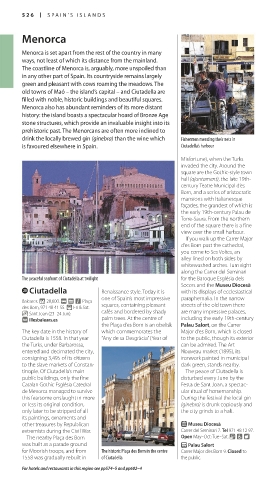
drink the locally brewed gin (ginebra) than the wine which Fishermen mending their nets in
is favoured elsewhere in Spain. Ciutadella’s harbour
Misfortune), when the Turks
invaded the city. Around the
square are the Gothic-style town
hall (ajuntament), the late 19th-
century Teatre Municipal d’es
Born, and a series of aristocratic
mansions with Italianesque
façades, the grandest of which is
the early 19th-century Palau de
Torre-Saura. From the northern
end of the square there is a fine
view over the small harbour.
If you walk up the Carrer Major
d’es Born past the cathedral,
you come to Ses Voltes, an
alley lined on both sides by
whitewashed arches. Turn right
along the Carrer del Seminari
The peaceful seafront of Ciutadella at twilight for the Baroque Església dels
Socors and the Museu Diocesà
p Ciutadella Renaissance style. Today it is with its displays of ecclesiastical
one of Spain’s most impressive para phernalia. In the narrow
Baleares. * 28,600. @ g n Plaça
des Born, 971 48 41 55. ( Fri & Sat. squares, containing pleasant streets of the old town there
_ Sant Joan (23–24 Jun). cafés and bordered by shady are many impressive palaces,
∑ illesbalears.es palm trees. At the centre of including the early 19th-century
the Plaça d’es Born is an obelisk Palau Salort, on the Carrer
The key date in the history of which commemorates the Major d’es Born, which is closed
Ciutadella is 1558. In that year “Any de sa Desgràcia” (Year of to the public, though its exterior
the Turks, under Barba rossa, can be admired. The Art
entered and decimated the city, Nouveau market (1895), its
consigning 3,495 of its citizens ironwork painted in municipal
to the slave markets of Constan- dark green, stands nearby.
tinople. Of Ciutadella’s main The peace of Ciutadella is
public buildings, only the fine disturbed every June by the
Catalan Gothic Església Catedral Festa de Sant Joan, a spectac-
de Menorca man aged to survive ular ritual of horsemanship.
this fearsome onslaught in more During the festival the local gin
or less its original condition, (ginebra) is drunk copiously and
only later to be stripped of all the city grinds to a halt.
its paint ings, ornaments and
other treasures by Republican E Museu Diocesà
ex tremists during the Civil War. Carrer del Seminari 7. Tel 971 48 12 97.
The nearby Plaça des Born Open May–Oct: Tue–Sat. & 7 8
was built as a parade ground P Palau Salort
for Moorish troops, and from The historic Plaça des Born in the centre Carrer Major d’es Born 9. Closed to
1558 was gradually rebuilt in of Ciutadella the public.
For hotels and restaurants in this region see pp574–5 and pp602–4
526-527_EW_Spain.indd 526 26/09/17 11:03 am
Eyewitness Travel LAYERS PRINTED:
Catalogue template “UK” LAYER
(Source v2.1)
Date 5th December 2012
Size 125mm x 217mm

