


Page 533 - (DK Eyewitness) Travel Guide - Spain
P. 533
THE BALEARIC ISLANDS 531
Ancient Menorca
Menorca is exceptionally rich in pre historic remains – the island has been described as an
immense open-air museum. The majority of the sites are the work of the “talayot” people
who lived between 2000 BC and 1000 BC and are named after the talaiots or huge stone
towers that characterize the Menorcan landscape. There are hundreds of these Bronze Age
villages and structures dot ted around the island. Usually open to the public and free of
charge, these sites provide an invaluable insight into the ancient inhabitants of the Balearics.
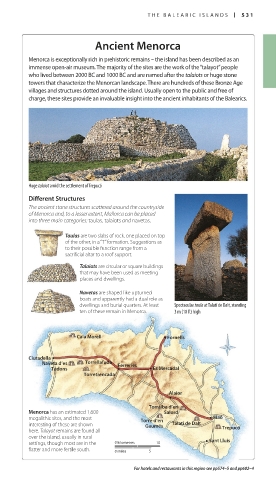
Huge talaiot amid the settlement of Trepucó
Different Structures
The ancient stone structures scattered around the countryside
of Menorca and, to a lesser extent, Mallorca can be placed
into three main categories: taulas, talaiots and navetas.
Taulas are two slabs of rock, one placed on top
of the other, in a “T” formation. Suggestions as
to their possible function range from a
sacrificial altar to a roof support.
Talaiots are circular or square buildings
that may have been used as meeting
places and dwellings.
Navetas are shaped like upturned
boats and apparently had a dual role as
dwellings and burial quarters. At least Spectacular taula at Talatí de Dalt, standing
ten of these remain in Menorca. 3 m (10 ft) high
Cala Morell Fornells
Ciutadella
Naveta d’es Torrellafuda Ferreries
Tudons Es Mercadal
Torretrencada
Alaior
Torralba d’en
Menorca has an estimated 1,600 Salord
megalithic sites, and the most Torre d’en Maó
interesting of these are shown Gaumés Talati de Dalt Trepucó
here. Talayot remains are found all
over the island, usually in rural
settings, though most are in the 0 kilometres 10 Sant Lluís
flatter and more fertile south. 0 miles 5
For hotels and restaurants in this region see pp574–5 and pp602–4
530-531_EW_Spain.indd 531 26/09/17 11:03 am

