


Page 560 - (DK Eyewitness) Travel Guide - Spain
P. 560
558 TR A VELLERS ’ NEEDS
WHERE TO STAY
Luxury hotels set in medieval castles, man sions hotels on the Costa del Sol and in the Balearic
converted into youth hostels, designer B&Bs and the Canary Islands. Visitors can stay on
in the heart of buzzing cities – there is a huge remote farms, or in old, self-catered villas.
range of places to stay in Spain. The country For budget travel there are pensions, family-
has some 10,000 establish ments and over one run casas rurales, guest houses and camp sites,
and a half million beds to choose from; it’s no as well as refuges with stunning views for
wonder that tourism sustain’s Spain’s economy. mountaineers. Some of the best hotels in all
Suites in once-royal palaces are at the top of these categories and in every style and
the scale and then there are luxury beach price range are listed on pages 562–75.
individual style, and has a
restaurant offering regional
cuisine. They are generally
well signposted.
If you plan to tour in high
season or to stay in the smaller
paradors, be sure to reserve in
advance. The paradors may be
booked through the Central de
Reservas or through London
agent Keytel International.
Prices
Spanish law requires all hotels
to display their prices behind
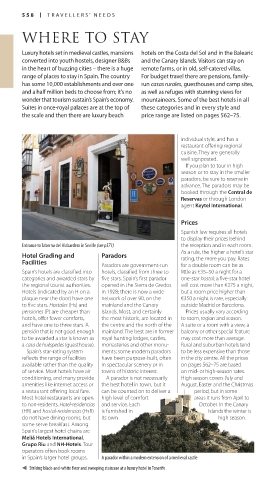
Entrance to Taberna del Alabardero in Seville (see p571) the reception and in each room.
As a rule, the higher a hotel’s star
Hotel Grading and Paradors rating, the more you pay. Rates
Facilities Paradors are government-run for a double room can be as
Spain’s hotels are classified into hotels, classified from three to little as €35–50 a night for a
categories and awarded stars by five stars. Spain’s first parador one-star hostal; a five-star hotel
the regional tourist authorities. opened in the Sierra de Gredos will cost more than €275 a night,
Hotels (indicated by an H on a in 1928; there is now a wide but a room price higher than
plaque near the door) have one network of over 90, on the €350 a night is rare, especially
to five stars. Hostales (Hs) and mainland and the Canary outside Madrid or Barcelona.
pensiones (P) are cheaper than Islands. Most, and certainly Prices usually vary according
hotels, offer fewer comforts, the most historic, are located in to room, region and season.
and have one to three stars. A the centre and the north of the A suite or a room with a view, a
pensión that is not good enough mainland. The best are in former balcony or other special feature
to be awarded a star is known as royal hunting lodges, castles, may cost more than average.
a casa de huéspedes (guesthouse). monasteries and other monu- Rural and suburban hotels tend
Spain’s star-rating system ments; some modern paradors to be less expensive than those
reflects the range of facilities have been purpose-built, often in the city centre. All the prices
available rather than the quality in spec tacular scenery or in on pages 562–75 are based
of service. Most hotels have air- towns of historic interest. on mid- or high-season rates.
conditioning, and many provide A parador is not nec essarily High season covers July and
amenities like internet access or the best hotel in town, but it August, Easter and the Christmas
a restaurant offering local fare. can be counted on to deliver a period, but in some
Most hotel restaurants are open high level of com fort areas it runs from April to
to non-residents. Hotel-residencias and service. Each October. In the Canary
(HR) and hostal-residencias (HsR) is furnished in Islands the winter is
do not have dining rooms, but its own high season.
some serve breakfast. Among
Spain’s largest hotel chains are
Meliá Hotels International,
Grupo Riu and NH-Hotels. Tour
operators often book rooms
in Spain’s larger hotel groups. A parador within a modern extension of a medieval castle
Striking black-and-white floor and sweeping staircase at a luxury hotel in Tenerife
558-559_EW_Spain.indd 558 26/09/17 11:03 am
Eyewitness Travel LAYERS PRINTED:
Practical template “UK” LAYER
(Source v1.6)
Date 7th January 2013
Size 125mm x 217mm

