


Page 557 - (DK Eyewitness) Travel Guide - Spain
P. 557
THE C ANAR Y ISLANDS 555
Volcanic Islands
The volcanic activity which formed the Canary Islands has created a variety of
scenery, from distinctive lava formations to enormous volcanoes crowned by
huge, gaping craters. The islands are all at different stages in their evolution.
Tenerife, Lanzarote, El Hierro and La Palma are still volcanic ally active; dramatic
displays of flames and steam can be seen in Lanzarote’s Montañas de Fuego
(see p552). The last eruption was on La Palma in 1971.
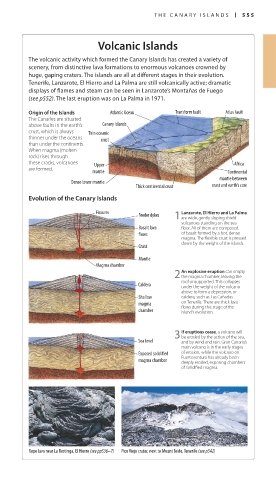
Origin of the Islands Atlantic Ocean Transform fault Atlas Fault
The Canaries are situated
above faults in the earth’s Canary Islands
crust, which is always Thin oceanic
thin ner under the oceans crust
than under the con tinents.
When magma (molten
rock) rises through
these cracks, volcanoes Upper Africa
are formed. mantle Continental
mantle between
Dense lower mantle
Thick continental crust crust and earth’s core
Evolution of the Canary Islands
Fissures Lanzarote, El Hierro and La Palma
Feeder dykes
1 are wide, gently sloping shield
volcanoes standing on the sea
Basalt lava floor. All of them are composed
flows of basalt formed by a hot, dense
magma. The flexible crust is pressed
down by the weight of the islands.
Crust
Mantle
Magma chamber
An explosive eruption can empty
2 the magma chamber, leaving the
roof unsupported. This collapses
Caldera under the weight of the volcano
above to form a depression, or
Shallow caldera, such as Las Cañadas
magma on Tenerife. There are thick lava
flows during this stage of the
chamber island’s evolution.
If eruptions cease, a volcano will
3 be eroded by the action of the sea,
Sea level and by wind and rain. Gran Canaria’s
main volcano is in the early stages
Exposed solidified of erosion, while the volcano on
magma chamber Fuerteventura has already been
deeply eroded, expos ing chambers
of solidified magma.
Rope lava near La Restinga, El Hierro (see pp536–7) Pico Viejo crater, next to Mount Teide, Tenerife (see p542)
554-555_EW_Spain.indd 555 26/09/17 11:03 am

