


Page 582 - (DK Eyewitness) Travel Guide - Spain
P. 582
580 TR A VELLERS ’ NEEDS
What to Drink in Spain
Spain is one of the world’s largest wine-producing countries
and many fine wines are made here, particularly reds in
La Rioja and sherry in Andalucía. Many other beverages –
alcoholic and non-alcoholic – are served in bars and cafés,
which provide an important focus for life in Spain. The
Spanish are also great coffee drinkers. In the summer,
a tempting range of cooling drinks is on offer, in addition
to beer, which is always available. Brandy and a variety of
liqueurs, such as anís, are drunk as apéritifs and digestifs, Customers enjoying a drink at a terrace
as is chilled pale gold fino sherry.
café in Seville
Hot chocolate
A plate of churros
(batter sticks)
Café con leche Camomile Lime flower
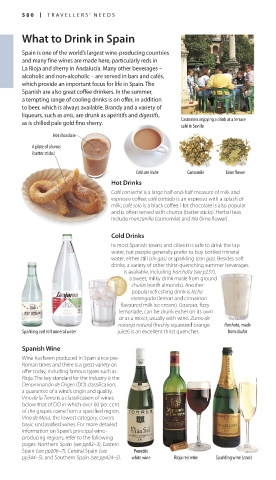
Hot Drinks
Café con leche is a large half-and-half measure of milk and
espresso coffee; café cortado is an espresso with a splash of
milk; café solo is a black coffee. Hot chocolate is also popular
and is often served with churros (batter sticks). Herbal teas
include manzanilla (camomile) and tila (lime flower).
Cold Drinks
In most Spanish towns and cities it is safe to drink the tap
water, but people generally prefer to buy bottled mineral
water, either still (sin gas) or sparkling (con gas). Besides soft
drinks, a variety of other thirst-quenching summer beverages
is available, including horchata (see p257),
a sweet, milky drink made from ground
chufas (earth almonds). Another
popular refreshing drink is leche
merengada (lemon and cinnamon
flavoured milk ice cream). Gaseosa, fizzy
lemonade, can be drunk either on its own
or as a mixer, usually with wine. Zumo de
naranja natural (freshly squeezed orange Horchata, made
Sparkling and still mineral water juice) is an excellent thirst quencher. from chufas
Spanish Wine
Wine has been produced in Spain since pre-
Roman times and there is a great variety on
offer today, including famous types such as
Rioja. The key standard for the industry is the
Denominación de Origen (DO) classi fication,
a guarantee of a wine’s origin and quality.
Vino de la Tierra is a classification of wines
below that of DO in which over 60 per cent
of the grapes come from a specified region.
Vino de Mesa, the lowest category, covers
basic unclassified wines. For more detailed
information on Spain’s principal wine-
producing regions, refer to the following
pages: Northern Spain (see pp82–3), Eastern
Spain (see pp206–7), Central Spain (see Penedès
pp344–5), and Southern Spain (see pp424–5). white wine Rioja red wine Sparkling wine (cava)
580-581_EW_Spain.indd 580 26/09/17 11:03 am
Eyewitness Travel LAYERS PRINTED:
Practical template “UK” LAYER
(Source v1.6)
Date 7th January 2013
Size 125mm x 217mm

